12.11.2024
557

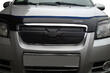
A winter cover for the radiator grille is the simplest way to protect the radiator for winter and help the engine warm up faster in frost. But the question “what to cover the radiator grille with” has several answers: a factory model-specific cover, a cover with insulation, a DIY “cardboard shield,” or film. We break down how they differ, which grille to cover—upper, lower, or both—when to install and remove the cover, and how to choose the right one for your car.
Contents
A winter cover (also called a winter plug, “mask,” or winter grille) is a plastic panel shaped like the factory grille that installs over it and partially blocks the flow of cold air to the radiator. The factory grille is not removed or drilled: the cover attaches to it with the included hooks or clamps.
Why you need it. The radiator is designed for summer heat and full load, so in frost it cools the engine with a big margin. The thermostat tries to maintain operating temperature, but while driving, icy air still cools the engine, so it takes a long time to warm up and the heater blows cool air. The cover reduces this airflow—and you get several practical effects:
This is most noticeable on diesels and on vans with a large grille: such engines take a long time to warm up in frost, and on vans the area where cold air passes through is especially large. At idle, airflow is already small, so the cover’s main effect is while driving.
The neatest option. The cover matches the shape of a specific vehicle’s grille, installs in a few minutes without special tools, and is just as easy to remove in spring. Our product pages list the material—ABS plastic or polystyrene—and the installation type: hooks or clamps, included in the kit. The cover is not airtight: there are gaps between it and the grille, so air still passes through—just less of it.
For some models, for example Volkswagen T5 2003–2010, the product page includes a “Matte with insulation” option—a cover with an additional layer of thermal insulation. Another approach is to cover the radiator with insulating material yourself. Here it is important not to block the entire cross-section: leave open areas so air can pass through when the engine is under load.
A DIY “cardboard shield” is an old folk method, and as a temporary measure it works. But cardboard gets wet, softens, and can get lodged between the fins, and film tears in the wind. If you fasten such a cover with wire or zip ties directly to the radiator, it is easy to bend the thin aluminum fins. So if the car is driven every day all winter, it is better to install a cover that attaches to the grille, not the radiator.
In most cars, cold air reaches the radiator in two ways: through the upper grille between the headlights near the badge, and through the grille or air intake in the bumper. That’s why covers come in upper and lower versions, and for some vans, for example Renault Trafic and Opel Vivaro 2001–2015, there are also middle ones above the license plate. They are sold separately.
The selection logic is simple: if the car is driven mostly on the highway and warms up normally, one cover is often enough. If there is a lot of city driving, short trips, and hard frost, both are installed. But there are models where there is no choice: for Renault Megane III 2009–2013 there is only a lower cover, for Hyundai Santa Fe 2 and Opel Astra G only an upper cover, and for Renault Kangoo 2013–2020 only a lower one.
All covers in the catalog are black, and most product pages have a shade switch—matte or glossy. This is mainly about appearance: glossy is closer to the lacquered plastic of modern grilles, while matte shows small scratches from sand and salt less. For some models, the shades also differ by material: in the specs, matte versions are listed as ABS plastic, glossy ones as polystyrene. So check the specifications on your product page.
There is no universal temperature at which the cover must be installed: it all depends on the engine, driving conditions, and how much of the grille you are covering. A practical guideline is the car itself. The cover is installed when, in cold weather, the engine takes noticeably longer to warm up and the heater takes a long time to produce heat. It is removed in spring, when the frost is over.
The main control is the engine temperature gauge. It should reach the value your car normally runs at and not rise above it in a traffic jam, under load, or with a trailer. If during a thaw or on an uphill the needle goes above normal—remove the lower cover or both. We covered the risks, symptoms, and when a cover can do harm in detail in the article “Winter grille cover: when it helps the engine and when it hurts”.
One more thing to think about in advance: if there is an adaptive cruise control radar, a camera, or parking sensors in the grille or bumper, the cover must not block them. Check this against the photos on the product page.
A winter cover is chosen not by the year in the registration documents, but by the grille shape: within one generation, the front end often changed after a facelift, and the “before” and “after” covers are not interchangeable. The most reliable way is to compare your grille with the photo on the product page, and if in doubt, send a photo of the front end to the manager. To help you avoid mistakes, we have prepared separate guides for the most popular models.
| Vehicle type | What to cover | Where to choose |
|---|---|---|
| Volkswagen T4, T5, T6, Caddy | upper, lower, or both; on T4 it depends on whether the front end is “straight” or “slanted” | VW guide, Volkswagen covers |
| Mercedes Sprinter and Vito | radiator grille, and on Vito W639 also the opening in the bumper | Mercedes guide, Mercedes covers |
| Renault Master, Trafic, Kangoo, Opel Vivaro, Ford Transit | upper, lower; on Trafic and Vivaro also middle | van guide, Renault covers |
| Skoda Octavia Tour, A5, A7, Superb | upper and lower separately, different before and after facelift | Skoda guide, Skoda covers |
| Passenger cars: Megane III, Aveo T250, Lanos, Lacetti, Astra G, Passat B6, Santa Fe 2 | depending on the model—lower only, upper only, or both | passenger-car guide, Opel covers |
If your model is not in the table, open the winter radiator grille covers section and choose the make and model—everything in the catalog is collected there.
The installation itself takes a few minutes: clean the grille from dirt and snow, position the cover, hook the hooks behind the bars of the factory grille or tighten the clamps, and fix the cover evenly at all points. After the first trip, it is worth checking the fasteners and tightening them if necessary.
The cover is only part of winter preparation. To make sure the cooling system gets through the frost without surprises, check a few things:
We deliver via Nova Poshta across Ukraine; orders from 15 000 ₴ are delivered free of charge by our own transport.
Shipping to EU
Wholesale and retail
Own warehouse
Опис продукту
Подарунки не надаються при оформленні покупки у кредит під 0,01% або при покупці частинами.