23.02.2026
278

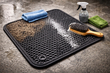
EVA floor mats are loved for their practicality: the “honeycomb” texture holds water and debris, and the material itself is easy to rinse clean. That’s why many drivers switch to these car mats and never want to go back to carpet. But there’s a nuance: if you don’t maintain EVA, the mat will start “accumulating” moisture, sand in the cells, and even odors. The good news is that proper care for EVA mats takes very little time if you do it regularly, not just “once a season.”
In this guide you’ll find simple, hands-on steps: how to wash EVA mats, how to clean car mats without a car wash, how to remove sand from the cells, how to dry mats so there’s no dampness underneath, and what to do if an odor appears. If you’re only choosing a set, start with the EVA floor mats section — it’s easier to find the right format for your car and your conditions.
Daily care isn’t “washing” — it’s quick upkeep that prevents dirt from moving into “hard mode.” It’s especially relevant in the shoulder seasons and in winter, when water and sand get into the cabin every day.
The key: water must leave the mat regularly. If water sits inside the cells for weeks, it starts “living its own life,” along with odor and dampness.
After heavy rain or snow, it’s best to pull the driver’s mat out first and pour out the water right away. The driver’s side gets the most moisture from footwear, and that’s where “swamp” forms the fastest.
A thorough wash is needed when debris has packed into the cells, stains appear, or the mat simply looks “tired.” You can wash EVA quickly, but it’s important to do it correctly — then the mat won’t feel sticky, won’t attract dust, and won’t smell.
At the car wash, it’s important not to overdo the chemicals. Often, water + a light shampoo is enough, and “super-alkaline” products are best left for the bodywork, not interior accessories.
A Kärcher is the fastest way to wash “sand out of the cells,” but you need to do it correctly so you don’t “blast” dirt back in and don’t damage the edging (if present).
If you’re curious why EVA behaves this way in care and how it differs from carpet and rubber, see the comparison of EVA vs rubber and carpet. And a basic explanation of the material and the “cells” is here: what EVA floor mats are.
Drying is the main reason dampness appears in the cabin. The mat can be clean, but if you put it back wet “overnight” in a cold cabin, moisture will remain underneath, and under the mat you’ll create an ideal environment for odors.
A separate winter care mode is described in the article how to use EVA mats in winter. It includes simple habits that reduce “swamp” under your feet and the risk of odors.
Sand in the cells is classic. It’s not “scary,” you just need to remove it correctly: don’t smear it around — wash it out or shake it out in the right direction.
The most effective way is to wash sand out with a water jet at an angle. If you pour “straight down” without tilting, some sand will simply “roll” between the cells.
Best after the beach, forest, or active trips. The main thing is not too close and not too long in one spot. Let the water wash the cells out gradually.
If there’s sand in the trunk, EVA is an ideal scenario because the mat can be easily removed and rinsed. If you haven’t installed a trunk mat yet, check the guide EVA trunk mat — it covers selection and formats.
With EVA, odor is almost always related not to the “material,” but to moisture and what’s sitting in the cells. The most common causes are water that isn’t drained, road chemicals, dirty mats left wet for a long time, or “organic” residue (food, drinks, dirt from walks).
| Problem | Cause | What to do | What to avoid |
|---|---|---|---|
| The mat is “always wet” | Water accumulates in the cells and isn’t drained | Drain after trips, dry on a slope | Putting it back into the cabin wet |
| Sand is stuck in the cells | Sand has compacted; dry shaking isn’t enough | Rinse at an angle or use a Kärcher at a distance | Pouring water without tilting (sand “rolls” inside) |
| Odor in the cabin | Dampness under the mat, road chemicals, organic residue | Wash, rinse thoroughly, dry completely | Masking it with an air freshener without cleaning |
| Sticky surface | Leftover chemicals or too concentrated a product | Wash again and rinse well | Using strong alkali/concentrates |
| White streaks/film | Salt, road chemicals, poor rinsing | Wash with neutral shampoo, rinse | Leaving road chemicals “until spring” |
| Dampness under the mat | Mat is wet, cabin isn’t ventilated | Dry the mat and the floor, ventilate | Driving for weeks with a wet mat |
| Season | Cleaning frequency | Best method | Comment |
|---|---|---|---|
| Summer | Once every 7–14 days | Dry shaking + light rinse as needed | More dust, less water; short procedures are enough |
| Autumn | 1–2 times a week | Drain water + rinse at an angle | Rain and dirt quickly build up in the cells |
| Winter | 2–4 times a week (more often if needed) | Drain daily + car wash/Kärcher once a week | Road chemicals and snow create lots of water; drying is important |
| Spring | 1–2 times a week | Rinse + thorough rinsing | Dirt and dust, sometimes lots of sand; wash the cells out well |
Caring for EVA mats is simple: shake them out regularly, drain water, rinse at an angle, and dry them so there’s no dampness under the mat. The most common issues (sand in the cells, film from road chemicals, odor) are solved not by “super chemicals,” but by the right routine: water + neutral shampoo + thorough rinsing + full drying. If it’s important that cleaning takes minimal time, it makes sense to choose EVA mats that are easy to wash for your model and usage format.
Yes, it’s one of the most effective ways to wash sand out of the cells. Keep a distance (not up close), work at an angle, and don’t hold the jet in one spot for too long. After that, be sure to rinse thoroughly and dry.
Drain the water after trips, let it run off, and dry the mat vertically or on a slope. Don’t put a wet mat back overnight in a cold cabin. Additional winter tips are in the article how to use EVA mats in winter.
Rinse the mat with water, apply a neutral car shampoo, brush through the cells, and rinse thoroughly. It’s important not to leave road chemicals for long and not to use aggressive alkali “for soaking.”
First rinse with water, then use a neutral shampoo and a brush, focusing on the cells. Then rinse thoroughly and dry. In most cases, EVA cleans easier than carpet.
Odor is usually caused by dampness under the mat or dirt/organic residue left in the cells. The solution: wash, rinse well, fully dry the mat and the floor under it, and ventilate the cabin. If the cause is winter water and road chemicals, clean more often and drain water regularly.
Shipping to EU
Wholesale and retail
Own warehouse
Опис продукту
Подарунки не надаються при оформленні покупки у кредит під 0,01% або при покупці частинами.