19.04.2026
321
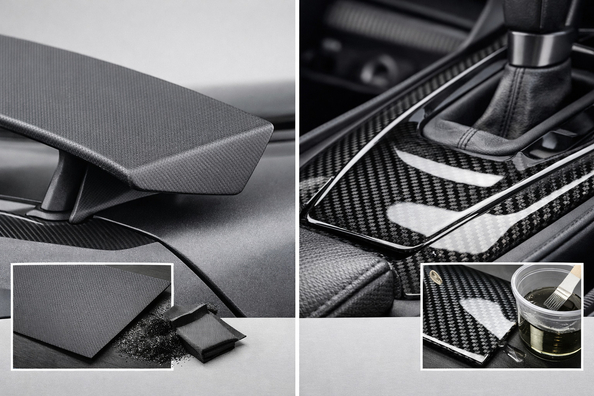
If you need a decorative trim piece, an interior insert, or a small exterior element without strict requirements for weight and accuracy, high-quality wet carbon is usually enough. But if we’re talking about an expensive exterior part, noticeable geometry, minimum weight, and a stable fit, then dry carbon more often justifies the extra cost.
The key nuance is that the name alone guarantees nothing. Under “dry carbon,” sellers may mean different technologies, so you should look not only at the weave pattern, but also at the manufacturing method, the clear coat quality, the back side of the part, and the mounting points.
Dry carbon in tuning usually means a part made from prepreg material, where the resin content is controlled before the part is formed. This results in lower weight, better repeatability, and more accurate geometry. Wet carbon is made by impregnating the fabric with resin during layup, so the result depends more on the process, vacuum work, and production precision.
So the choice isn’t between “good” and “bad,” but between two approaches. For decorative trim, the difference often comes down to budget, finish, and fitment. For loaded or very visible exterior parts, stiffness, weight, and shape stability become more important.
| Option | Strengths | Weaknesses | Who it’s for |
|---|---|---|---|
| Dry carbon | Lower weight, higher stiffness per unit weight, more accurate geometry, more consistent surface quality | Higher price, more complex production, sensitive to cure-cycle quality, more expensive repairs | For expensive exterior parts, spirited driving, projects where fitment and appearance matter |
| Wet carbon | Cheaper, easier to produce, more practical for small batches, decorative elements, and repairs | Higher risk of excess resin, voids, surface waviness, lower repeatability | For city cars, interior inserts, small trim pieces, and scenarios without strict weight requirements |
DD Tuning expert comment: Most often, people make mistakes when they judge carbon only by gloss and the weave pattern. In practice, more problems are caused by weak clear coat, inaccurate molding, and mounting points that make the part rub or vibrate. For exterior elements, we recommend checking fitment and coating first, and only then paying extra for a flashy technology name.
Its strong point is controlled resin content and better layer consolidation. That’s where the more accurate shape, lower porosity, lower weight, and usually a better surface grade come from. In real life, you feel this on large or very visible parts: mirror caps, splitters, hoods, inserts with complex geometry.
But dry carbon shouldn’t be seen as an automatic quality guarantee. If the manufacturer cut corners on clear coat, UV protection, or mounting points, an expensive part can still yellow, lose gloss, or start “living its own life” at speed.
This is a more affordable and flexible approach. It works well for decorative trim pieces, small body elements, custom work, and situations where budget matters more than every gram. If the part is made carefully, ideally with vacuum consolidation, the result can be very decent.
The weak point is a stronger dependence on manufacturing discipline. Excess resin, bubbles, local unevenness, less stable repeatability between batches—these are typical issues here. That’s why a well-made wet carbon part is often better than a poorly made “dry” one in name only.
For a city car where carbon is mostly decorative, the wet option is usually sufficient. You won’t feel the weight difference, and the money saved is better spent on a quality clear coat and proper installation.
For exterior parts that are constantly in view, dry carbon is more appealing due to more precise fitment and a more consistent appearance. This is especially noticeable where even gaps and clean edge geometry matter.
For spirited driving, high speeds, or parts that work under load, the advantage of dry carbon increases. It’s stiffer and more predictable, which means fewer chances of vibrations, microcracks from part flex, or shape issues.
For repairs, one-off orders, and budget custom work, wet carbon is more practical. Here, paying extra for a more complex technology often doesn’t pay back in real benefits.
| Scenario | What to choose | Why |
|---|---|---|
| Interior inserts, small decorative trim pieces | Wet carbon | The weight difference is almost irrelevant, while budget and practicality matter more |
| Mirror caps, noticeable exterior trim | Dry carbon or very high-quality wet | You need precise fitment, an even finish, and decent coating durability |
| Splitter, diffuser, hood for spirited driving | Dry carbon | Stiffness, lower weight, and shape stability at speed are crucial here |
| Budget exterior refresh | Wet carbon | Delivers the desired look without overpaying for specs you may not need |
| Custom work, small batch, possible local repairs | Wet carbon | Easier to adapt, cheaper to restore, and simpler to work with in small runs |
Paying extra for dry carbon is logical when the part is large, visible, complex in shape, or works under load. It’s also justified if you truly track weight, want the most accurate fitment without modifications, and aren’t willing to tolerate waviness, excess resin, or inconsistent repeatability.
If it’s for the interior, small trim pieces, or simply adding a carbon accent, the more expensive option isn’t always better. In that case, it’s smarter to look for a well-made part with a proper coating than to chase wording in the product name.
For a practical choice, it’s worth first checking out carbon trim pieces, separately clarifying what is meant by natural carbon, and for exterior elements reading the breakdown about mirror covers. This makes it easier to filter out decorative “carbon-look” solutions from parts where the technology truly matters.
From a customer’s experience: a coupe owner was choosing carbon for interior inserts and mirror caps and initially wanted a dry option for everything. In the end, they chose quality wet carbon for the interior, and a more expensive option with better geometry and coating for the exterior parts. This combination delivered a reasonable budget without the feeling of overpaying somewhere—or, on the contrary, choosing something too basic.
Dry carbon is usually better where you need lower weight, higher stiffness, precise fitment, and a stable appearance. Wet carbon is strong in budget, decorative, and repair scenarios where practicality and a fair price matter.
So the right question isn’t “which carbon is cooler,” but “which part is it for and under what usage conditions.” This material is based on real selection experience, hands-on practice, and real-world scenarios: in many cases, what proves decisive isn’t the loud names, but manufacturing quality, coating, and installation.
| ✔ | Dry carbon is lighter and stiffer, so it is suitable for large or highly loaded exterior parts. This is especially useful where shape stability at speed matters. |
| ✔ | Dry carbon usually has more precise geometry and better consistency, so it fits better without adjustments. For mirror caps, splitters, and hoods, this reduces the risk of misalignment and gaps. |
| ✔ | Wet carbon is usually cheaper and easier to produce. For interior inserts, small trim pieces, and decorative elements, this is often enough. |
| ✔ | Wet carbon is more practical for repairs, one-off orders, and small batches. It is easier to adapt to budget or custom tasks. |
| ✔ | For a city car, where carbon mainly serves a decorative purpose, the wet version delivers a solid result without paying extra for unnecessary characteristics. |
| ✘ | Dry carbon is more expensive and more complex to produce, and repairing such parts can also cost more. The extra cost is not always justified if the part does not work under load. |
| ✘ | The name “dry carbon” by itself does not guarantee quality. If they saved on lacquer, UV protection, or mounts, an expensive part can also quickly lose its appearance or start vibrating. |
| ✘ | Wet carbon depends more heavily on manufacturing discipline. It has a higher risk of excess resin, voids, surface waves, and less stable quality between batches. |
| ✘ | For complex or noticeable exterior parts, wet carbon more often loses out in fit accuracy and shape stability. If even gaps and clean geometry are needed, this can become a problem. |
Shipping to EU
Wholesale and retail
Own warehouse
Опис продукту
Подарунки не надаються при оформленні покупки у кредит під 0,01% або при покупці частинами.