11.03.2026
478
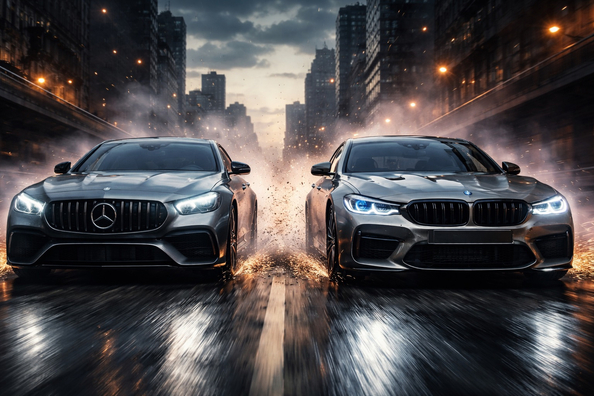

Executive summary. The “Mercedes or BMW” debate almost never comes down to “which is better.” Most often it’s about different owner priorities: comfort vs driving excitement, calm vs adrenaline, status vs sporty character—as well as reliability, service budget, and real everyday convenience. The Ukrainian info space also regularly circles back to queries like “which is better Mercedes or BMW”—because the answer depends not on the logo, but on the tasks. citeturn4view1turn3search3
In this article—a lively but strict comparison with no “winner”: what owners actually compare, why people switch from BMW to Mercedes (and vice versa), where club discussions boil over, and which topics most often trigger flame wars between fans. citeturn4view0turn2search3turn2search0
As a rule, search demand forms around simple phrases like “which is better,” “which is more reliable,” and “which is more expensive to maintain,” as well as around the criteria “comfort/dynamics/costs.” These wordings are used directly in headlines and materials across the Ukrainian segment, which reflects the “people’s” logic of searching for an answer quite well. citeturn4view1turn4view2turn3search3
Further on, these phrases are used naturally in the text, without “over-salting.” Please don’t ask for additional SEO tips—instead, let’s align on your real selection criteria and how you actually use the car.
When the “Mercedes or BMW” conversation starts, owners usually argue not about the “better brand,” but about what you feel in day-to-day use: comfort and quietness, dynamics and “response,” reliability and typical surprises, the cost of service and parts, plus image (and how the car is “read” by others). These poles—driving excitement versus comfort—are often described as different brand philosophies. citeturn4view0turn4view1
Comfort. Here the discussion quickly turns subjective: some value “float” and quietness, others—“tightness” and composure. Even in comparison articles, Mercedes is often associated with comfort and BMW with driving excitement, but with a caveat about model/suspension/tires (in this article, specific models are not specified). citeturn4view0turn4view1
Dynamics. The key word here is “steering feel.” That’s what BMW fans cling to most, while Mercedes supporters respond: “fast enough, but calmer and more solid.” citeturn4view0turn2search7
Reliability. This is the hottest zone, because on forums two truths coexist: “mine has been trouble-free for years” and “never again.” That’s why it’s more rational to look at the condition of the specific car and its service history (not the mythology of the badge). citeturn2search25turn3search1
Maintenance cost. The internet loves bold numbers, but even specialized publications admit: it’s hard to say unequivocally “who’s more expensive,” because different jobs/parts can vary in price in different directions; sometimes you’ll see estimates of around a 10% difference in total service cost—though with the caveat that it depends on specifics. If your model/year/engine/mileage are not specified, then absolute conclusions here are also “not specified.” citeturn4view2
Image. It’s not only “status,” but also self-identification. No wonder brand slogans amplify different emotions: BMW often emphasizes driving pleasure, while Mercedes emphasizes a maximalist standard of quality. citeturn5search0turn5search3turn5search6
If you want to jump straight to a “dry” comparison—here’s the quick comparison table.
| Comfort | Dynamics | Reliability | Cost | Image |
|---|---|---|---|---|
| Mercedes: more often described as “smooth/quiet,” with a focus on convenience | Mercedes: “enough,” but without an обязательный “sporty edge” | Mercedes: opinions are polarized; the condition of the specific car decides | Mercedes: “it depends”; publications cite difference estimates, but no universal rule | Mercedes: associations with prestige and “classic status” |
| BMW: often described as “composed,” sometimes stiffer for the sake of control | BMW: more often described in terms of “response,” handling, and excitement | BMW: just as polarized; a lot depends on service history | BMW: can start out more affordable, but options/repairs “eat up” the difference (it depends) | BMW: image of a “driver’s car,” sporty character |
| Not specified: class/suspension/tires/sound insulation | Not specified: engine/transmission/drivetrain/tuning | Not specified: mileage/use/repair history | Not specified: service region/parts prices/maintenance format | Not specified: for whom exactly “status” matters and why |
Important: this isn’t a verdict on “which is better Mercedes or BMW,” but a map of the typical arguments that most often show up in comparisons. citeturn4view0turn4view1turn4view2
Real-life experience of people who “switched” is almost always down-to-earth: the reason is rarely just one thing. Usually it’s a mix of “I want different feelings,” “my needs changed,” “I’m tired of certain compromises,” “I need a different seating position/comfort/character.” These motives are clearly visible in owner discussions on forums and in communities: some, after moving to Mercedes, praise the smoothness and comfort; others return to BMW for the “driver-focused” concentration. citeturn2search0turn2search3turn2search7
Case summary: BMW → Mercedes. The most common wording is “I want more calm,” “I’m tired of constant driving excitement,” “I need quiet and softness,” “the feeling of solidity matters more.” People who remain satisfied usually highlight comfort/smoothness as the main win. citeturn2search0turn2search10
Case summary: Mercedes → BMW. Here you often hear “I want more response and excitement,” “I want to feel the road,” “the ‘driver focus’ logic is closer to me.” Owners who didn’t “settle in” with Mercedes often cite the lack of the sporty character they’re used to in BMW as the reason. citeturn2search4turn2search7
To avoid drowning in other people’s emotions, it helps to ask yourself two questions: “When do I drive most often—and how exactly?” and “What really annoys me in my current car?” If you don’t have answers, then the input data for an “honest battle of the titans” is still not specified.
A separate layer of the “Mercedes or BMW” standoff is club culture. In Ukraine, both BMW and Mercedes have active communities with forum threads about club life, mutual help, meetups, and ownership discussions. citeturn3search4turn3search0turn3search6turn3search1
And now—the part many people read these articles for: friendly jokes. They work like a “password” inside the scene—without malice, but with a playful jab.
Dark (but interesting) topics that spark debates: “reliability vs electronics complexity,” “cost of ownership and ‘unexpected’ jobs,” “do you need to pay for the image,” “what matters more: steering feel or cabin quiet.” Since specific models/generations are not specified, these debates almost always converge on one thing: the condition of the individual car and an honest budget decide. citeturn4view2turn2search25
Recommendation from DD Tuning: if BMW is closer to you, go to the accessories and tuning section /tyuning-bmw.html. If Mercedes is more “your” thing—select accessories and tuning here: /tyuning-mercedes.html.
Shipping to EU
Wholesale and retail
Own warehouse
Опис продукту
Подарунки не надаються при оформленні покупки у кредит під 0,01% або при покупці частинами.