













































 Author: Radomskyi Maksym Vasyliovych
Kia K9 (in the US — K900, in some export markets — Quoris) is Kia’s flagship rear-wheel-drive sedan, produced in two generations since 2012. The second generation (code RJ) debuted in 2018, received a major facelift in 2021, and on July 6, 2026 Kia confirmed that K9 production will end in late 2026 without a successor. Below is how the generations differ, which engines were offered for each, and what the facelift changed.
Contents
- What the Kia K9 is and what names it is known by
- What the first-generation K9 (2012–2018) was
- What changed in the second generation (2018)
- What the 2021 facelift brought
- Technical specifications of the generations in a table
- What changed in the K9 for the 2025 model year
- Why Kia is discontinuing the K9
- How to maintain and upgrade a K9 today
What the Kia K9 is and what names it is known by
K9 is the largest and most expensive sedan in Kia’s history. In Korea it has always been called K9; in the US and Canada it was sold as K900; and in Russia, the Middle East, and other export markets for the first generation — as Quoris. Kia later dropped the Quoris name after losing a trademark dispute, so the second generation in most markets already carried the K9 or K900 name.
Technically, the K9 is related to Genesis sedans: the first generation shares a platform with the first Hyundai Genesis, while the second uses the M2 platform that underpins the second-generation Genesis (since 2019 — Genesis G80). Hence the classic layout: longitudinal engine, rear-wheel drive, all-wheel drive as an option, and an 8-speed automatic.
What the first-generation K9 (2012–2018) was
The first K9 (code KH) debuted in South Korea in May 2012 and was produced until 2018. It is the one described on our site in the review of the Kia Quoris executive sedan. Length — 5 090 mm (after the update — 5 095 mm), wheelbase — 3 045 mm, width — 1 900 mm.
- 3.3 V6 — about 300 hp;
- 3.8 GDI V6 — 334 hp;
- 5.0 V8 Tau — about 420 hp, appeared later and became the main engine of the American K900.
All versions had an 8-speed automatic and rear-wheel drive. The main difference from the second generation is a shorter wheelbase and older electronics: KH did not yet have large screens, predictive shifting, or advanced driver assists.
What changed in the second generation (2018)
The second generation (RJ) was shown in March 2018 at the New York Auto Show, and sales in Korea started in May of the same year. The body grew to 5 120 mm, the wheelbase to 3 105 mm (+60 mm versus the first generation), and the width to 1 915 mm. In addition to rear-wheel drive, all-wheel drive appeared.
There were three engines at launch: the naturally aspirated 3.8 GDi V6 (315 hp, 397 Nm), the turbocharged 3.3 T-GDi V6 (370 hp, 510 Nm), and the 5.0 V8 (425 hp, 520 Nm). The V8 stayed in the lineup until 2021. In the US, the second-generation K900 was sold only with the turbo V6, and in 2021 Kia removed the model from the American market.
In Korea the start was successful: 11 843 cars in 2018 and more than 18 000 in 2019. In 2020 sales dropped to 7 831 — competition intensified from the new Genesis G80 with a 3.5 turbo engine.
What the 2021 facelift brought
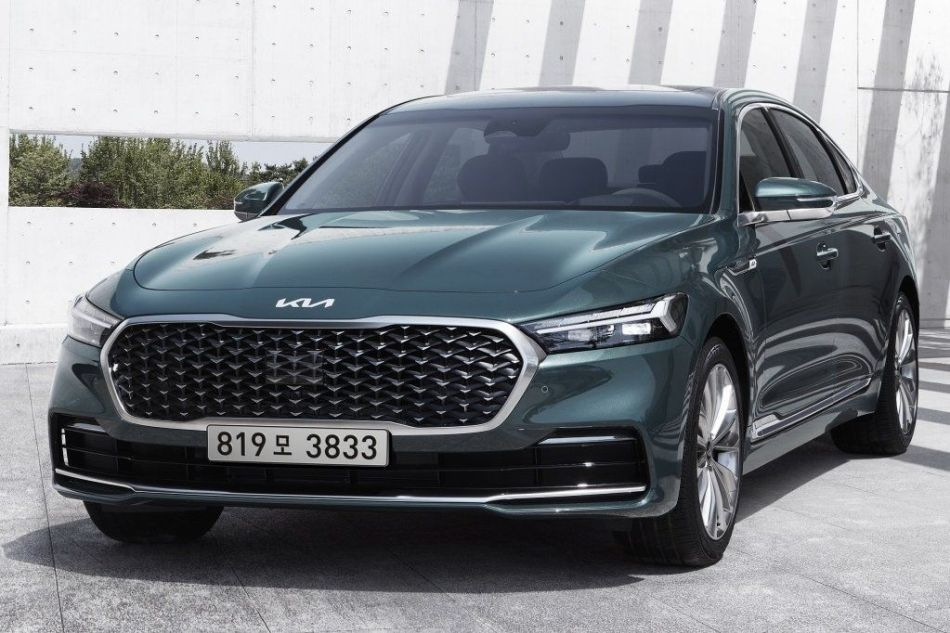
Kia showed the first photos of the updated K9 on May 17, 2021, and sales of “The New K9” in Korea began on June 15, 2021. This was the first update since 2018, and it is most often what people mean when they say “new K9.”
Exterior
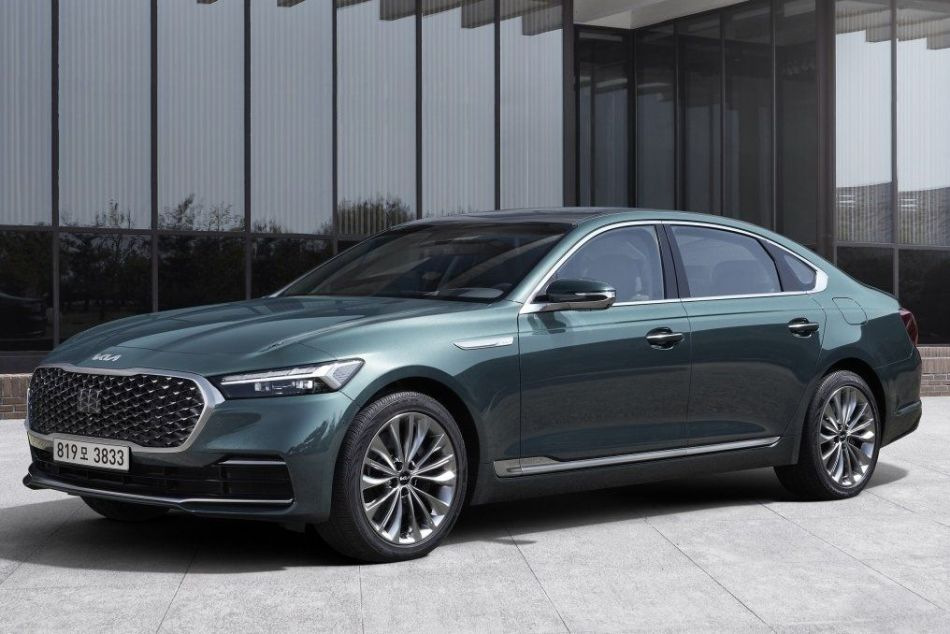
- a larger grille and the new Kia logo;
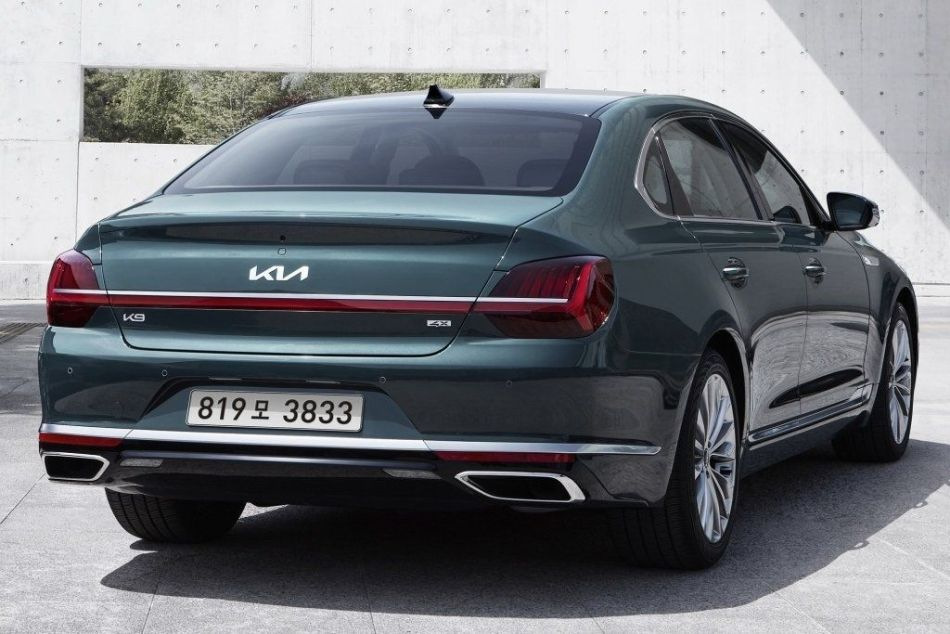
- different bumpers and lighting, with the rear lights in a single strip;
- length increased to 5 140 mm — 20 mm more than the pre-facelift RJ.
Interior and electronics
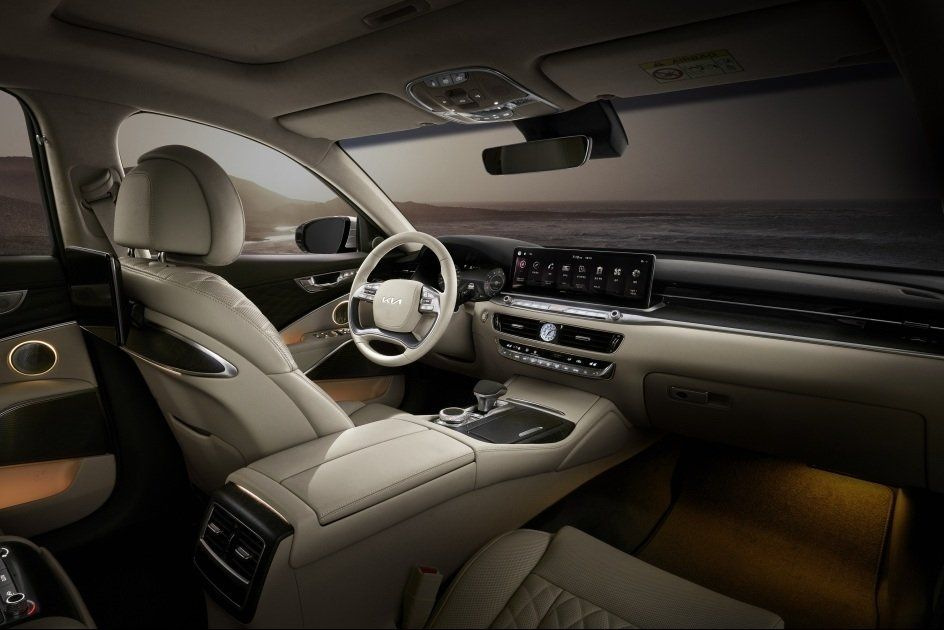
- 14.5-inch central display;
- fingerprint recognition for starting and settings;
- a control panel with handwriting recognition;
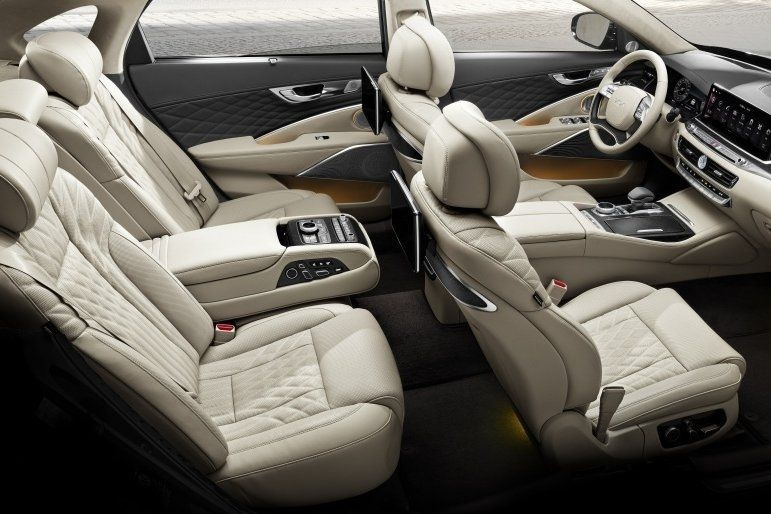
- Ergo Motion seats, quilted leather trim;
- PGS predictive shifting: using navigation and camera data, the car switches modes before highways or winding roads and slows down by itself ahead of speed cameras;
- highway driving assist with lane-change support, multi-collision braking system, electronically controlled suspension.
Engines and prices
After the facelift, two gasoline V6 engines remained in Korea — 3.8 GDi (315 hp) and 3.3 T-GDi (370 hp); the V8 was removed from the lineup. There were two trims — Platinum and Masters. Launch prices: from 56,94 million won (3.8 Platinum) to 76,08 million won (3.3 T-GDi Masters).
Technical specifications of the generations in a table
| Parameter | 1st generation KH (2012–2018) | 2nd generation RJ (2018–2021) | 2nd generation, facelift (2021–2026) |
| Length, mm | 5 090 / 5 095 | 5 120 | 5 140 |
| Width, mm | 1 900 | 1 915 | 1 915 |
| Wheelbase, mm | 3 045 | 3 105 | 3 105 |
| Engines | 3.3 V6, 3.8 V6, 5.0 V8 | 3.8 V6, 3.3 turbo V6, 5.0 V8 | 3.8 V6, 3.3 turbo V6 |
| Power, hp | ≈300 / 334 / ≈420 | 315 / 370 / 425 | 315 / 370 |
| Transmission | 8-speed automatic | 8-speed automatic | 8-speed automatic |
| Drivetrain | rear-wheel drive | rear-wheel drive or all-wheel drive | rear-wheel drive or all-wheel drive |
What changed in the K9 for the 2025 model year
In spring 2024, Kia refreshed the K9 once again for the 2025 model year. The grille received horizontal slats instead of the V-shaped pattern, 19-inch wheels appeared, along with the Pebble Gray color and new interior colors Martian Brown and Misty Gray. Equipment added a front passenger seat massage, USB-C ports front and rear, and the After Blow function — it dries the air-conditioner evaporator after the engine is switched off so that odors do not appear in the cabin. Engines remained the same: 3.3 T-GDi and 3.8 GDi, rear-wheel drive or all-wheel drive. Prices in Korea — equivalent to 43 800 to 64 200 dollars.
Why Kia is discontinuing the K9
On July 6, 2026, Kia confirmed that the K9 will be discontinued at the end of 2026, without a facelift, a new generation, or a direct successor. The reason is sales: 6 585 cars in Korea in 2022, 1 870 in 2024, 1 581 in 2025, and 734 in the first half of 2026. Kia is reallocating the freed plant capacity to electric vehicles and commercial PBV, and the brand’s largest sedan becomes the front-wheel-drive Kia K8. The closest spiritual successor within the group is the second-generation Genesis G90.
How to maintain and upgrade a K9 today
In Ukraine, the K9 is rare, so there are hardly any model-specific body kits made for it. That is why universal solutions work for this sedan: a front lip splitter, side skirt extensions, a rear diffuser, and a spoiler for the trunk lid. They are selected by bumper width and edge shape — on the long K9 body, they emphasize the low silhouette without overloading the restrained design. The bumpers of the pre-facelift and facelift RJ have different shapes, so before buying, confirm the generation and the car’s year. Options for the brand are in the Kia tuning section, and plastic elements are in the body kits for Kia category.
We deliver via Nova Poshta across Ukraine.