















































 Author: Radomskyi Maksym Vasyliovych
Hyundai Tucson is one of the most popular crossovers in Ukraine and Europe. The 2018 model year is not a new generation, but a facelift of the third generation (factory index TL), which had been produced since 2015. The updated version was unveiled in spring 2018, and it is the one most often searched for on the used market: it is more modern than the pre-facelift, yet noticeably cheaper than the current Tucson NX4.
Contents
- Key points in 30 seconds
- Hyundai Tucson generations: where 2018 fits in
- What the 2018 facelift changed
- Dimensions
- Engines and transmissions
- What to check when buying a used 2018 Tucson
- Tuning and accessories for Hyundai Tucson TL 2018
- Conclusion
Key points in 30 seconds
- Generation: third (TL), 2018 facelift; produced until the fourth generation NX4 appeared in late 2020.
- Body: five-door crossover about 4.48 m long, wheelbase 2670 mm.
- Engines: 1.6 and 2.0 L petrol, 1.6 T-GDI turbo-petrol, 1.6 and 2.0 CRDi diesels; front-wheel drive or all-wheel drive.
- What’s new: different grille, headlights and bumpers, a new interior with a tablet-style screen, SmartSense driver-assistance systems.
- Accessories: floor mats, window deflectors, door-sill covers and roof rails are shared across all TL 2016–2021; bumper trims are different for the pre- and post-facelift versions.
Hyundai Tucson generations: where 2018 fits in
| Generation | Years | In brief |
|---|---|---|
| First, JM | 2004–2010 | compact crossover based on Elantra |
| Second, LM | 2009–2015 | sold in Europe and Ukraine as Hyundai ix35 |
| Third, TL | 2015–2020 | the 2018 facelift is the focus of this article |
| Fourth, NX4 | since late 2020 | new design, hybrid versions |
Accessories for each generation are separated in the catalog: Hyundai Tucson JM, Hyundai Tucson TL 2016–2021, Hyundai Tucson NX4.
What the 2018 facelift changed
Exterior
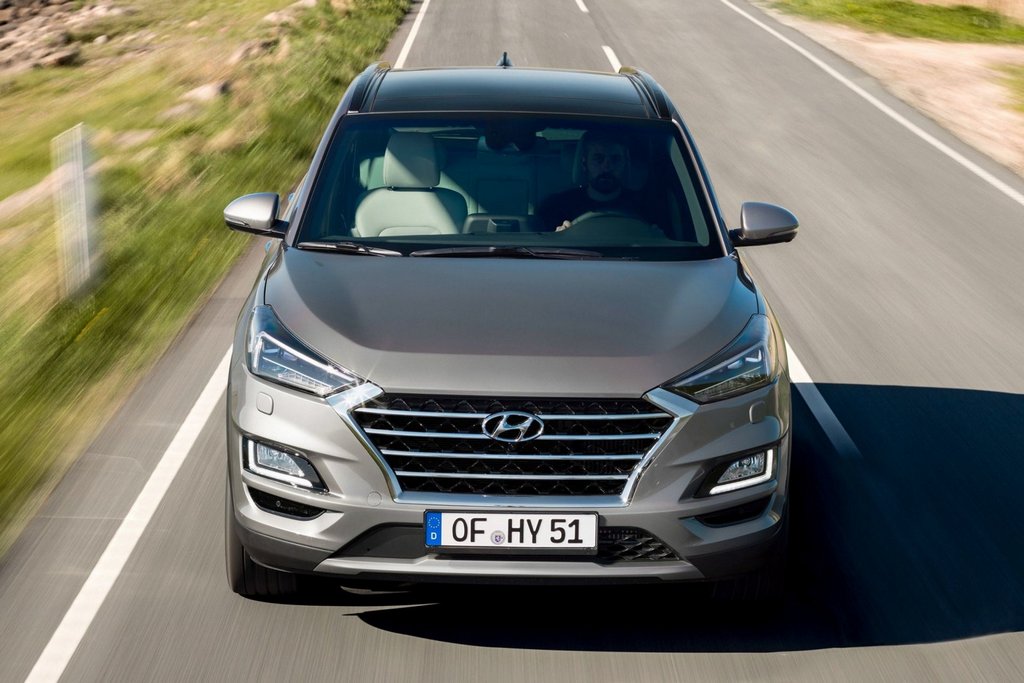
- new cascading grille;
- different headlights and daytime running lights; on higher trims — LED lighting;
- reworked front and rear bumpers, new rear lights;
- new wheel designs.
The easiest way to tell the 2018+ version from the pre-facelift is by the grille and the bumpers. This matters when choosing bumper trims: parts for 2016–2018 and for 2019–2021 are not interchangeable.
Interior
- new dashboard with the multimedia unit as a separate tablet-style screen on the panel;
- Apple CarPlay and Android Auto support;
- Hyundai SmartSense driver-assistance package (depending on trim: automatic braking, lane keeping, driver fatigue monitoring, adaptive cruise control).
Dimensions
| Parameter | Value |
|---|---|
| Length | about 4480 mm |
| Width | 1850 mm |
| Height | 1645–1650 mm |
| Wheelbase | 2670 mm |
| Ground clearance | about 172–182 mm (depends on version) |
| Trunk | about 488 L, with the seats folded — up to ~1480 L |
Engines and transmissions
The engine lineup depended on the market. The most common options:
| Engine | Power | Transmission |
|---|---|---|
| 1.6 GDI petrol | about 132 hp | manual |
| 2.0 MPi petrol | about 150–155 hp | manual or 6-speed automatic |
| 1.6 T-GDI turbo-petrol | 177 hp | manual or 7-speed DCT |
| 1.6 CRDi diesel | 115 or 136 hp | manual or 7-speed DCT |
| 2.0 CRDi diesel | 185 hp | 8-speed automatic; in Europe there was a version with a 48 V mild hybrid |
Drive is front or all-wheel: the rear wheels are engaged via a clutch when the front wheels slip. Combined fuel consumption is roughly 7–8.5 L/100 km for petrol versions and 5–6.5 L/100 km for diesels.
What to check when buying a used 2018 Tucson
- Naturally aspirated petrol engines: oil consumption and compression. This engine family can develop cylinder scoring, so knocking when cold and increased oil consumption are reasons for a detailed diagnosis.
- 1.6 T-GDI and DCT: smooth take-off, jerks in traffic jams, transmission control unit errors. The DCT clutch does not like constant city “start–stop” driving.
- Diesels: condition of the particulate filter and EGR valve, especially if the car was used mostly in the city on short trips.
- All-wheel drive: whether the rear-axle coupling was serviced, and whether there is any humming from the rear differential.
- Body: signs of accident repairs, paint thickness, condition of the sills and the lower part of the doors.
- Documents: VIN history, true mileage, service book.
Tuning and accessories for Hyundai Tucson TL 2018
The TL body did not change from 2015 to 2021, so most accessories are universal for the entire generation. Only bumper parts differ.
- EVA floor mats — do not soak through, hold dirt and water in the cells, easy to wash; the most practical choice for autumn and winter.
- Window deflectors (wind deflectors) — let you ventilate the cabin in the rain and reduce window fogging.
- Mud flaps — protect the sills and rear doors from dirt and road chemicals.
- Door-sill covers — protect the paint on the door sills from shoe scuffs.
- Roof rails and roof rack — for a box, bicycles, or skis.
- Body kits and bumper trims — separately for 2016–2018 and 2019–2021 versions.
- Fog lights — for versions that do not have them from the factory.
All products for this generation are collected on the Hyundai Tucson TL 2016–2021 tuning page. We deliver via Nova Poshta across Ukraine; orders from 15 000 ₴ — free delivery with our own transport.
Conclusion
Hyundai Tucson 2018 is a successful compromise on the used market: a modern interior and safety systems after the facelift, a wide choice of engines, and affordable spare parts. Before buying, it is worth checking the engine and transmission using the list above, and when choosing accessories — take into account whether your car is pre- or post-facelift, when it comes to bumper trims.