17.02.2026
210

More on the topic: Land Cruiser 400 — rebooting the legend.
Important: everything below is unofficial rumors and assumptions from the market and insider discussions. At the time of publication, this information is not confirmed by the manufacturer, and specifications, dates, and prices may change significantly or not reflect reality at all.
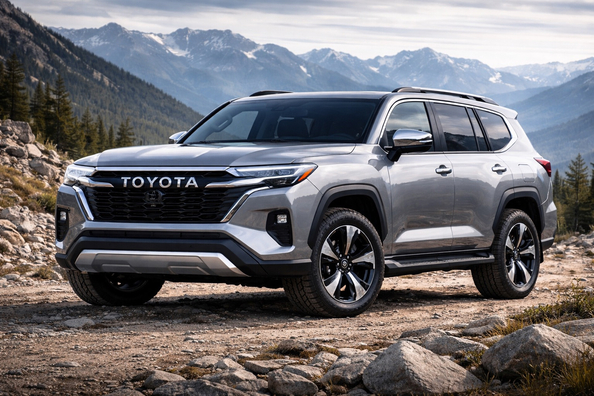
According to rumors, in 2027 a new generation of the legendary body-on-frame SUV – Toyota Land Cruiser 400 – may enter the global market. It is often called the potential successor to the Land Cruiser 300, allegedly combining traditional reliability and off-road capability with advanced eco-technologies. For the first time in the 70-year history of the series, this SUV may receive electrified versions: hybrid, fully electric, and even hydrogen fuel cell. At the same time, if these rumors prove true, the Land Cruiser 400 will likely retain the character of a true off-roader capable of tackling rough terrain, towing heavy trailers, and providing comfortable long-distance travel.
According to early leaks, the new Land Cruiser 400 may retain the recognizable rugged silhouette of its predecessors while gaining modern features. The body will likely become slightly sleeker for better aerodynamics: the windshield may be set at a steeper angle, and the A-pillars may be optimized to reduce wind noise. The front end will reportedly feature a redesigned grille and narrow matrix LED headlights for a futuristic look. Massive wheel arches and a high hood should emphasize power, while new rear LED lights visually widen the body. Dimensions are rumored to remain close to its predecessor: length ~5.2 m, width ~2 m, height ~1.9 m, wheelbase 2850 mm. Ground clearance of 235 mm should ensure excellent off-road geometry, with approach/departure angles around 32°/26° respectively.
It is also discussed that to reduce weight and increase strength, Toyota may use more lightweight alloys in the structure: aluminum hood, roof, and doors. The new TNGA-F platform chassis is rumored to remain body-on-frame, but the frame may become stiffer and lighter (about 100 kg lighter than LC300 — unofficial estimate). This could lower the center of gravity, improving handling. Wheel options are expected from 18–21 inches: smaller high-profile tires for off-road, or large stylish wheels for top urban trims. Overall, if leaks are accurate, the Land Cruiser 400 design should combine solidity and modernity, remaining a recognizable continuation of the legendary series.
Inside, the Land Cruiser 400, according to early descriptions, may feature a spacious and high-tech cabin for 7 passengers. The third row will likely be more comfortable: legroom may be increased, and the seats may fold electrically into the floor to create a flat cargo area. In the 5-seat configuration, an even larger luggage space may be available for expedition gear. Finishes — rumored — range from durable fabric and synthetic leather in utilitarian versions to premium perforated Nappa leather with wood and aluminum inserts in top trims. Front seats may offer 14-way electric adjustment, heating, ventilation, and even massage in the highest trim. The second row will likely have heating, separate climate control, and retractable sunshades.
The dashboard architecture, according to leaks, may become more digital: instead of analog gauges — a 12.3-inch fully digital cluster that may display navigation, hybrid system data, and 4WD modes. In the center, a 14-inch touchscreen of Toyota Smart Connect (with Apple CarPlay and Android Auto) is expected, with online updates. Passengers will likely get up to 6 USB-C ports, wireless phone charging, Wi-Fi hotspot, and 220V outlets (up to 1500W) — useful for camping or field work. Improved sound insulation is also mentioned (unofficially): multi-layer acoustic glass and active noise cancellation may make the cabin quieter even at speed. A panoramic roof and soft LED ambient lighting are also among expected options.
The biggest “revolution” attributed to the Land Cruiser 400 in rumors is its powertrain lineup. Depending on buyer needs, the legendary SUV will reportedly be offered in three high-tech variants: hybrid, electric, and hydrogen. All versions, if leaks are true, will retain the brand’s signature all-wheel drive and focus on reliability in tough conditions. Below are assumptions, not confirmed specs:
According to rumors, the hybrid Land Cruiser 400 may use a 3.5-liter twin-turbo V6 paired with an electric motor in a parallel hybrid setup. Combined output is said to be around 457 hp and 790 Nm of torque. The ICE and electric motor will likely work through a 10-speed automatic adapted for hybrid use, with a motor-generator and additional clutch between the engine and transmission. It’s also assumed that the LC400 can move on electric power alone at low speeds, while the motor assists during acceleration. 0–100 km/h acceleration is unofficially estimated at about 6.5 seconds.
Fuel economy is also described as noticeably better: consumption in mixed cycle may be around 10 l/100 km — unofficial figures compared to LC300 (13–14 l in real use). At steady highway speeds, the electric motor may help maintain cruising speed, reducing ICE load, while regeneration may recharge the battery. The hybrid battery is said to be lithium-ion, located under the second row. Plug-in charging likely won’t be required (classic hybrid). If these assumptions are close to reality, the hybrid LC400 may become a great compromise for long trips across Ukraine and Europe with good range.
The fully electric Land Cruiser 400 (EV), according to rumors, may get two electric motors — one per axle — providing AWD without mechanical differentials. Total output is said to be around 500 hp and torque over 1000 Nm (unconfirmed). Leaks also suggest 0–100 km/h in ~5 seconds. Power may come from a ~100 kWh battery under the floor, with range around 400 km (WLTP) — very rough estimates. Charging is expected via AC (e.g. 11 kW) and DC fast charging up to 150–200 kW (approx. 30–40 min to ~80%).
The EV version is described as attractive for cities and regions with developed charging infrastructure: zero emissions and low noise. Rumors also mention towing capacity up to 3.5 tons, though range drops significantly under load. “Smart” torque distribution between axles and reinforced protection for the battery/high-voltage components (even IP67 in some descriptions) are mentioned — but should be seen as marketing assumptions. For long expeditions, if the EV version appears, routes will need planning around chargers; in daily use, it theoretically offers maximum comfort and minimal costs.
The third variant most often mentioned in leaks is the Land Cruiser 400 with hydrogen fuel cells (FCEV). In this version, the vehicle may have an electric drivetrain (two motors on the axles), but energy is produced by a fuel cell stack based on Toyota Mirai experience. As with all FCEVs, the only emission is water. Hydrogen is said to be stored in 700-bar tanks, with total capacity around 10 kg H2 — theoretically giving 500–600 km range. Refueling time of 3–5 minutes is also often repeated in unofficial descriptions.
Power of the hydrogen version may be lower than the EV — around 400 hp, torque ~700–800 Nm. AWD logic is described like the EV: two motors and electronic torque control. It’s also noted (without confirmation) that total weight could be similar to the hybrid version, as tanks are lighter than a large battery, though fuel cells add weight. The key real-world issue — infrastructure: hydrogen stations remain rare, almost nonexistent in Ukraine. So even if an FCEV version appears, its role will likely be image/technology-oriented, “for the future.”
Leaks emphasize that Toyota allegedly ensured the Land Cruiser 400 doesn’t lose its legendary off-road capability with new technologies. On the contrary — the chassis and AWD systems may become even more advanced. The E-KDSS II (Electronic Kinetic Dynamic Suspension System) is often mentioned, which may automatically “release” stabilizers off-road for greater wheel travel, and on highways — provide stability without excessive roll. Suspension is described as independent double wishbone front and five-link rear, with longer shock travel. Premium versions may feature adaptive AVS dampers, and optionally air suspension with adjustable clearance (up to ~270 mm in “raised” mode — unofficial).
The traditional transfer case with low range is rumored to remain in the hybrid version. In electric and hydrogen variants, the low-range function may be replaced by an electronic traction control mode that limits speed and modulates torque. The Multi-Terrain Select system, according to leaks, may get an intelligent “Auto” mode that detects surface type (sand, mud, rocks, snow) and adjusts settings. Manual modes (Road, Mud, Sand, Rock, Snow, etc.) — up to 6 profiles — are also mentioned. For tough conditions, Crawl Control 2.0 and Turn Assist are rumored to help reduce turning radius and maintain ultra-low speed (2–10 km/h) on rough terrain.
On paved roads, the Land Cruiser 400 may become more “civilized” thanks to reduced weight, lower center of gravity, and a new variable-ratio electric power steering. Improved ride comfort and stability at speed are also assumed. Top speed is often cited as limited to ~180 km/h — typical for the class and not proof of actual plans.
According to unofficial materials, the Land Cruiser 400 may meet strict safety standards and receive the latest Toyota Safety Sense package. The most frequently mentioned features include:
Leaks also mention an extended passive safety set: up to 10 airbags (including driver knee and central front airbags) — but this should be seen as a forecast. As before, a strong frame structure, TPMS, and security sensors are expected.
Among technologies, 360° cameras and the Multi-Terrain Monitor with “transparent hood” view for off-road are often mentioned. Constant online connectivity (built-in 4G), mobile app for remote functions, eCall, and OTA software updates are also expected. The final feature set will depend on market (Ukraine/EU), trim, and manufacturer plans.
Below are conditional differences between LC300 and potential LC400 — this comparison is based on rumors and is not official:
| Specification | Land Cruiser 300 (J300, 2021) | Land Cruiser 400 (J400, expected/rumored) |
|---|---|---|
| Engines (max power) | 3.5 V6 petrol 409 hp; 3.3 V6 turbodiesel 299 hp | 3.5 V6 Hybrid ~457 hp; EV ~500 hp; FCEV ~400 hp (all unofficial) |
| Transmission & drive | 10-speed auto, permanent 4x4, low range | 10-speed auto (hybrid) or 1-speed reducer (EV/FCEV), permanent 4x4 in all versions (assumed) |
| Fuel economy | ~14 l/100 km (petrol), ~11 l/100 km (diesel) | ~10 l/100 km (hybrid); 0 l (electric/hydrogen) — rumored |
| Emission standard | Euro 6, high CO2 emissions | Euro 7 (hybrid); zero CO2 emissions (EV/FCEV) — expected |
| Chassis & suspension | Frame (GA-F platform), E-KDSS, coil suspension | Lighter frame (+20% rigidity), E-KDSS II, AVS, optional air — unofficial |
| Off-road equipment | Multi-Terrain Select (6 modes), Crawl Control, 2 diff locks (center+rear) | Auto Multi-Terrain, Crawl Control 2.0 + Turn Assist, up to 3 locks (center+rear+front in GR Sport) — leaked |
| Interior & multimedia | 12" display, analog gauges, 2-zone climate | 14" display (OTA), digital cluster, 4-zone climate, Wi-Fi, 220V outlets — expected |
| Safety systems | TSS 2.0, 8 airbags | TSS 3.0+, 10 airbags (added central and knee) — unconfirmed |
According to unofficial data, the world premiere of the Land Cruiser 400 may take place in autumn 2027, with sales possibly starting late that year in key markets. For Ukraine and Europe, this model is considered particularly significant: thanks to the hybrid powertrain that should meet stricter eco-standards (including Euro 7), the flagship Land Cruiser may be promoted more actively in the EU. On the Ukrainian market, the new model may appear almost simultaneously with Europe — first cars expected at dealers in early 2028, with pre-orders possibly opening closer to the premiere.
Estimated price of the new Land Cruiser 400 in Ukraine (unofficially) — from ~3.0–3.2 million UAH for the base hybrid (~€80,000). In the EU, starting prices are often mentioned at ~€75–80,000 (depending on country and taxes). The electric version or fully equipped trims, if they appear, may cost more — top versions could exceed €100,000 (over 4 million UAH). Several trims are assumed: standard, luxury Premium, and off-road GR Sport — but these are market scenarios, not confirmed lists.
As for warranty, rumors repeat the brand’s standard terms (3 years or 100,000 km), and extended coverage (5–8 years) for hybrid batteries and fuel cells. The rumored “high demand” should be taken cautiously: until actual sales start, real queues may not exist or depend on country quotas.
Toyota Land Cruiser 400 in unofficial discussions appears as an attempt to show that even the most traditional body-on-frame SUV can evolve with the times. If at least part of the rumors come true, combining hybrid/electric technologies with a frame structure and off-road focus may make the model very appealing to the market. For Ukrainian and European buyers, this could theoretically mean a “new chapter” where one doesn’t have to choose between eco-friendliness and all-terrain capability.
At the same time, let’s emphasize again: this is not official information. Actual specs, engine lineup, trims, prices, and dates depend on the manufacturer’s strategy, regulations, and markets. For now, the Land Cruiser 400 is more of an interesting hypothesis and discussion topic than a confirmed product.
Shipping to EU
Wholesale and retail
Own warehouse
Опис продукту
Подарунки не надаються при оформленні покупки у кредит під 0,01% або при покупці частинами.