














































 Author: Radomskyi Maksym Vasyliovych
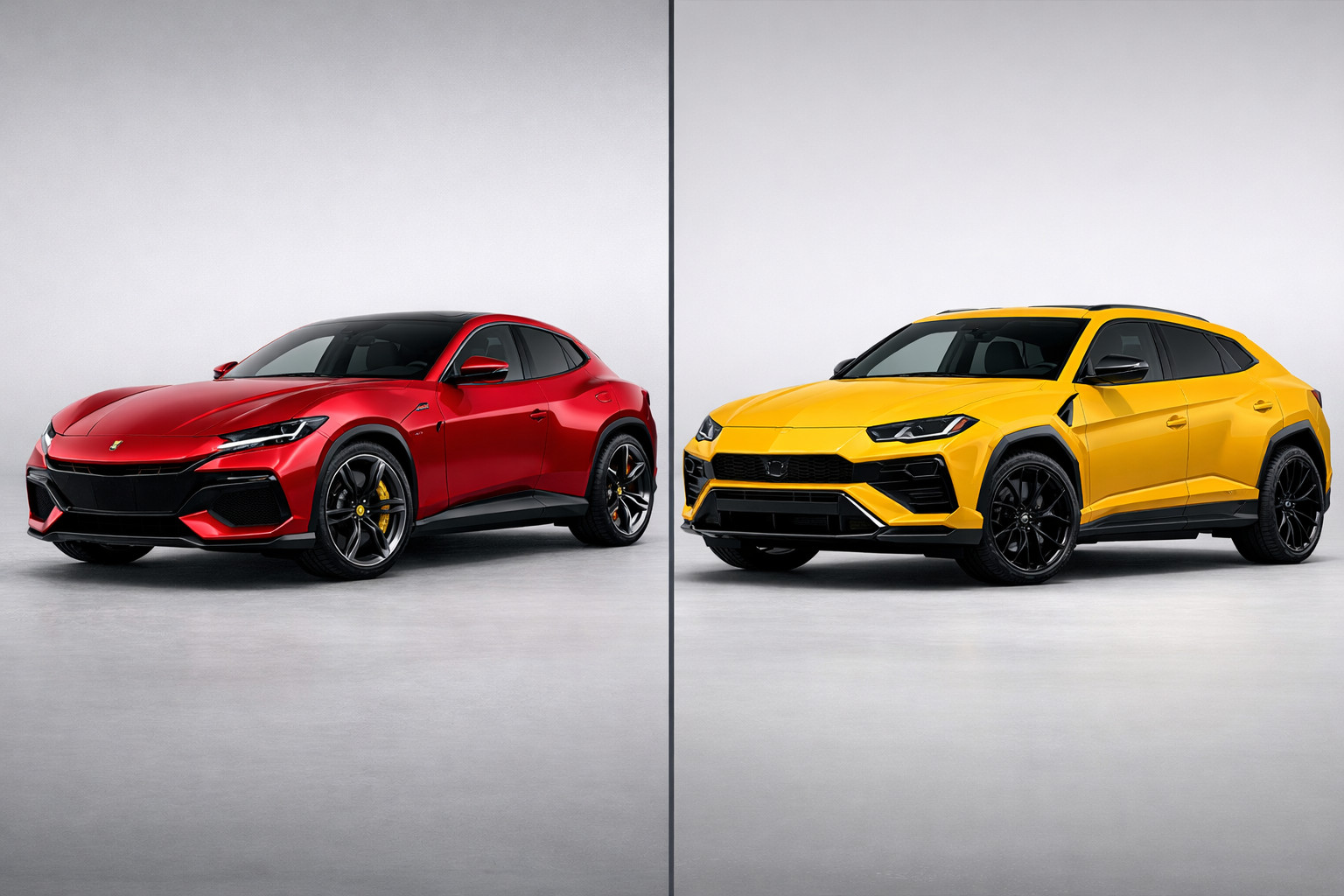
In short: the Ferrari Purosangue is worth buying for the emotion, the naturally aspirated V12, and the feeling of not a crossover, but a very fast four-door Ferrari with a high seating position. The Lamborghini Urus is stronger where a car needs to be daily, fast, and city-friendly at the same time—ready for winter and bad roads. But there’s an important caveat: today the Urus is no longer a single version, so for an honest choice you need to separate the Urus SE and the Urus S.
In real life, what makes the difference isn’t tenths of a second in acceleration, but road noise, the practicality of the trunk and second row, long-term mechanical complexity, the cost after options, and how convenient it is to use the car as a base for further tuning and accessories.
What the choice is really about
The Purosangue is the choice for someone who wants a Ferrari specifically, not just a very expensive fast crossover. The main arguments here are the naturally aspirated V12, four individual seats, a very strong chassis, and the character of a car that loves long, fast trips as much as it loves a vivid soundtrack and high revs.
The Urus SE follows a different logic. It wins not with romance, but with breadth of capability: 800 hp, an electric mode for the city, a rich set of electronics, strong traction on any surface, air suspension, and a more convincing fit for everyday use. If you don’t need a hybrid but want a simpler, more practical Urus, then the Urus S often looks more rational thanks to a larger trunk and less complex hardware.
Which criteria you should compare by
In a pairing like this, it makes sense to look not only at the spec sheet, but at five practical criteria.
- Accessory installation and compatibility. If you’re immediately thinking about wheels, carbon, body kits, or interior elements, what matters is not only design, but also the availability of ready-made solutions, fitment accuracy, and how much adjustment is required.
- Noise. In this class it depends heavily on tires, wheel diameter, and driving mode. The Purosangue usually feels more composed on long trips, while the Urus in sport settings can be noticeably louder specifically from tires and road noise.
- Durability and complexity. The Purosangue is still too new for hard conclusions about long-term durability, and the Urus SE adds the hybrid component. The Urus S is simpler to understand in this respect.
- Practicality. What matters here is trunk shape, second-row access, seating position, daily-use mode, winter, and rough surfaces. This is where the difference between the Purosangue, Urus SE, and Urus S is the biggest.
- Price. You should look not only at the starting point, but also options, servicing, consumption, and potential costs of personalization. Ferrari almost always lands in a higher price league.
| Criterion | Ferrari Purosangue | Lamborghini Urus SE | Lamborghini Urus S |
|---|---|---|---|
| Accessory installation and compatibility | Narrower selection, more precise fitment | More ready-made solutions | The easiest base for upgrades |
| Noise | Usually quieter and more composed on the highway | Can be loud in Sport | Depends on tires, but easier to tune for comfort |
| Durability and complexity | Newer model, long-term durability not yet obvious | More complex due to the hybrid | The simplest architecture of the three |
| Practicality | Good, but without real off-road margin | Best all-round versatility | Largest trunk |
| Price | The highest “emotional” price tag | Very expensive, but more rational | Often the most sensible balance of price and benefit |
Quick comparison of the options (table)
| Option | Strengths | Weaknesses | Who it suits |
|---|---|---|---|
| Ferrari Purosangue | Naturally aspirated V12, four individual seats, very strong chassis, quiet and mature highway behavior, 473 L trunk | Very high price after options, high fuel consumption, weaker suitability for real off-road use, narrower tuning logic and parts compatibility | For those who want maximum emotion and Ferrari character, with practicality in second place |
| Lamborghini Urus SE | 800 hp, electric mode for everyday city use, strong in winter and on bad roads, rich digital equipment, very quick launch | More complex hardware, smaller 454 L trunk, in sport modes it can be stiff and noisy | For those who need one versatile, very fast car for every day |
| Lamborghini Urus S | Larger 616 L trunk, simpler gasoline setup, clear everyday logic, strong practicality | Less exotic and technical novelty, not as impressive in feel as the Purosangue | For those who want an Urus not for hybrid complexity, but for convenience and everyday usefulness |
If you need a direct comparison of two current flagship ideas, then look at Purosangue versus Urus SE. If the question is practical, without the cult of new tech, the Urus S should also definitely be on the list.
DD Tuning expert comment: a typical mistake is to say “I want an Urus” without specifying SE, S, or Performante. They have different trunk logic, day-to-day convenience, and future costs. Another common mistake is choosing only by acceleration, without thinking about noise on large wheels and whether exterior tuning is planned—where the availability of compatible parts matters.
A detailed breakdown of each option
Ferrari Purosangue is the strongest on emotion. The naturally aspirated V12 delivers not just thrust, but a different way of building speed that the hybrid Urus can’t replicate. It has individual rear seats, a well-thought-out long-distance experience, and the feel of a car built around the driver. But it’s not a crossover for every task: ground clearance and the overall concept aren’t about real off-road use, and the entry price and options quickly pull it away from the rational field.
Urus SE is the broadest in functionality. It’s very close to Ferrari in launch dynamics, has an electric mode for short city trips, a strong set of drive modes, and a more convincing reserve of versatility. For winter, wet highways, rough asphalt, and city driving, this is often the calmer choice. The downsides are also obvious: the hybrid system adds complexity, the trunk is smaller than in the Urus S, and in sport settings comfort and acoustics depend on wheels and tires more than many people expect.
Urus S is an underrated option in this comparison. It’s not as overtly high-tech as the SE, but it gives you a 616 L trunk and a more straightforward gasoline architecture. If you need one expensive car for daily tasks, trips, and regular second-row use, the S often looks more sober than the SE and more practical than the Purosangue.
As a base for accessories and exterior upgrades, the Urus family looks simpler. It’s usually easier to find ready compatible solutions, and selecting components is less exotic. For the Purosangue, the choice is narrower and fitment accuracy is more critical—especially with wheels and parts where you can’t afford to miss on fit or proportions.
Which option is better for different scenarios
If you want a weekend car but aren’t willing to sacrifice long-distance comfort, the Purosangue delivers the most vivid feeling of a special vehicle. There’s less everyday compromise and more of what people buy a Ferrari for in the first place.
If the car will be driven daily, parked in the city, handle short trips, winter, slippery asphalt, and uneven roads, the Urus SE looks more practical. It’s not as romantic, but more convincing as the only car in the garage.
If the key word for you isn’t “emotion” but “stress-free daily life,” you should seriously consider the Urus S. It loses to Ferrari in uniqueness, but wins where the owner opens the trunk every day, carries stuff, and wants less complexity.
If you’re definitely planning personalization after purchase, the advantage shifts back toward the Urus. It’s easier to work with design, wheels, and body elements without the scenario where one beautiful idea turns into a long fitment journey.
| Scenario | What’s best to choose | Why |
|---|---|---|
| Daily city trips, parking garages, short routes | Lamborghini Urus SE | Electric mode, broader digital logic, and better city versatility |
| Long fast highways for driving feel | Ferrari Purosangue | V12, very strong chassis, four individual seats, and a more special character |
| Winter, slippery surfaces, bad roads | Lamborghini Urus SE | Air suspension, drive modes, and more convincing all-weather capability |
| Frequent trips with gear and a truly needed trunk | Lamborghini Urus S | The largest trunk of the three and more everyday practicality |
| Active exterior tuning is planned after purchase | Urus S or Urus SE | More ready-made solutions, simpler compatibility logic, and a wider range of upgrade directions |
Typical mistakes when choosing
- Comparing only 0–100 km/h acceleration. At this price, what matters more is how the car sounds, how it cruises on the highway, and how little it wears you out every day.
- Not clarifying which Urus is meant. SE, S, and Performante offer different balances of practicality, noise, and complexity.
- Thinking the Purosangue is just a Ferrari in a crossover body. In reality it’s closer to a very fast road car with a high seating position than to a vehicle for bad roads.
- Ignoring durability and technical complexity. The new Purosangue still has limited long-term experience, and the Urus SE has more complex modules than the Urus S.
- Forgetting about accessory installation. A beautiful project can easily fall apart if you don’t check wheel, carbon, or body-element compatibility before buying the car.
When a more expensive solution makes sense
Paying extra for the Purosangue makes sense when you need not just speed, but that rare feeling of a big Ferrari with a V12. The main value there isn’t in dry numbers, but in how the car sounds, responds, and feels even on an ordinary drive.
A higher budget for an Urus is justified in another case: when you want not only to buy a car, but to build a complete image around it. For that, it’s useful to immediately look at tuning for Urus, evaluate carbon trim pieces for targeted changes to the exterior, and also understand whether you need forged R23 wheels if correct fitment and proportions matter without random choices.
Put simply, Ferrari is worth buying for the uniqueness of the car itself, while the Urus is also worth it for how well it works as a platform for further personalization.
From a customer’s experience: one typical scenario is that someone initially wants the Purosangue for the V12 and status, but after a conversation about daily driving, winter, trunk space, and plans for exterior upgrades, moves to the Urus SE or Urus S. Most often, satisfaction comes when the car is chosen not with your heart in the first minute, but for the real usage pattern. If the main goal is emotion on every drive, then returning to the Purosangue looks perfectly logical.
Conclusion
The Ferrari Purosangue is for those who want the brightest character, a V12, and the feel of a special car—even at the cost of less rationality. The Lamborghini Urus SE is for those who need one very fast car for every role. The Urus S is for those who want maximum practicality without hybrid complexity.
The key is not to confuse emotion with versatility. This material is based on real selection experience, practice, and real usage scenarios: if you want character—take the Purosangue; if you need broad everyday functionality—look toward the Urus; and if you want the most level-headed balance of daily usability and power—don’t overlook the Urus S.
Pros and cons
Ferrari Purosangue delivers an atmospheric V12 and a more emotional driving feel than an ordinary fast crossover. It is the choice for those who value the car’s character, not just acceleration figures.
The Purosangue has four individual seats and well-thought-out track behavior, so it seems suitable for long, fast trips. According to the description, the car is less tiring on the road and feels like a more mature road car.
The Lamborghini Urus SE is better suited to everyday use: it has an electric mode for the city, air suspension, and strong traction on different surfaces. This makes it more convenient in the city, in winter, and on bad roads.
The Lamborghini Urus S looks like the more practical option thanks to its larger 616 l trunk and simpler gasoline setup. For everyday use, trips with luggage, and regular driving, it is less complex than the SE.
The Urus family is better suited as a base for tuning and accessories. It is easier to find ready-made compatible solutions for it, especially if wheels, carbon, or body elements are planned.
The Ferrari Purosangue is very expensive after options, and the article directly says it quickly goes beyond a rational budget. On top of that, it has high fuel consumption.
The Purosangue has no reserve for real off-road use, so its practicality is limited by the concept of a high road car rather than a universal SUV. It is less suitable for difficult conditions than the Urus.
The Urus SE got more complex hardware because of the hybrid setup, which increases long-term complexity. It also has a smaller trunk than the Urus S, and in sport modes it can be stiff and noisy.
The Urus S is more practical, but it falls behind the other versions in emotional appeal and technical novelty. If you want a bright effect or more modern logic, it looks less impressive.