















































 Author: Radomskyi Maksym Vasyliovych
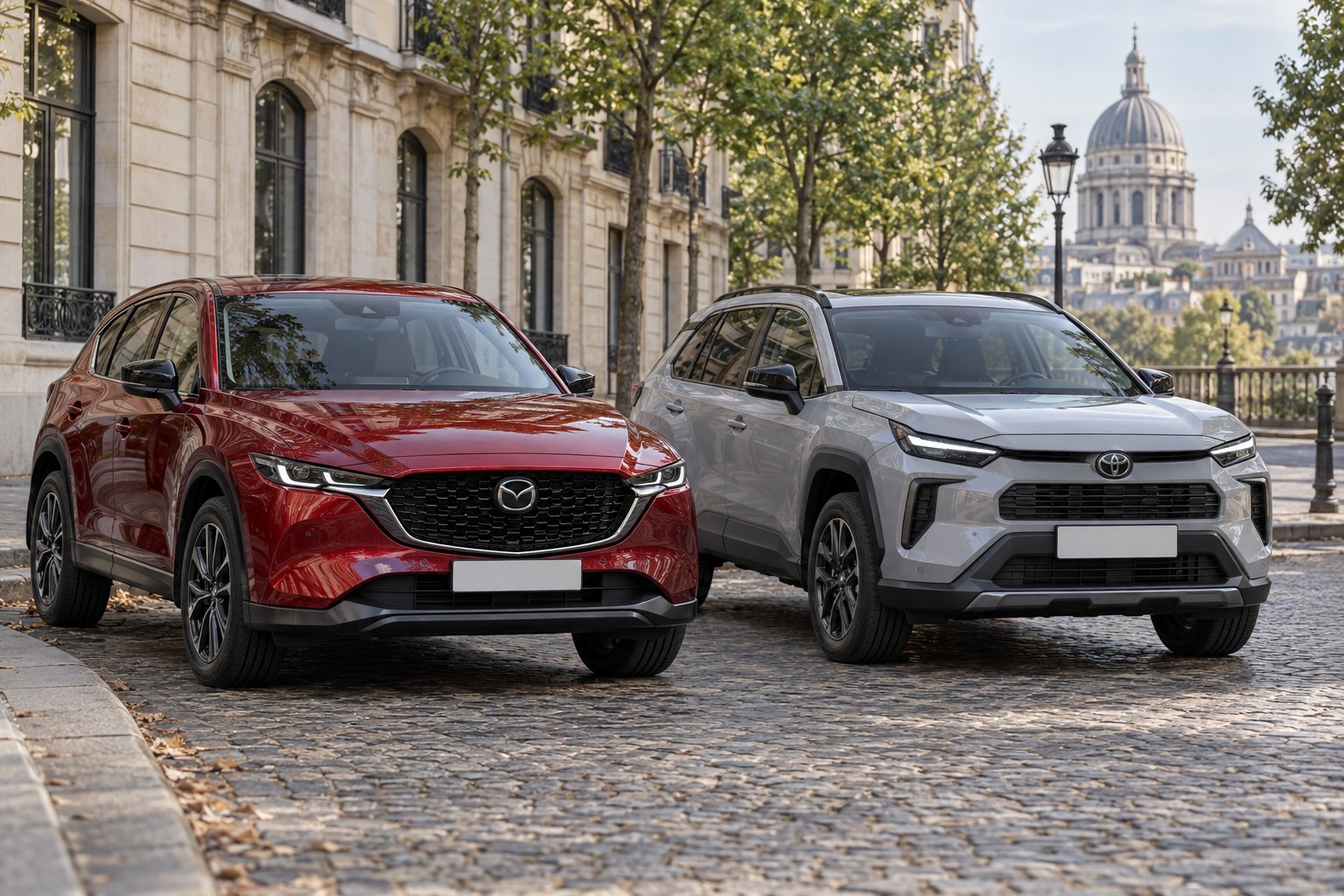
The third-generation Mazda CX-5 and the sixth-generation Toyota RAV4 are the main Japanese crossovers of 2025–2026, but they are built around different ideas. The new CX-5 (global premiere in Europe on July 10, 2025) remains a crossover with a single 2.5 L gasoline engine — in Europe it is a 141 hp mild hybrid — but it has become roomier and, for the first time for Mazda, received Google built-in, and from October 26, 2026 it also gets the Gemini assistant. The RAV4 (premiere on May 21, 2025) is hybrid-only: a full hybrid with 185–194 hp or a plug-in hybrid with 272–309 hp, with an electric-only range of up to 137 km. In short: CX-5 is for those who want simple mechanics without a plug, RAV4 is for those who want to use less fuel and charge at home.
Contents
- How the new Mazda CX-5 differs from the Toyota RAV4 in the key areas
- What specs the Mazda CX-5 and Toyota RAV4 have
- What’s under the hood: mild hybrid vs full hybrid and plug-in hybrid
- Where there’s more space in the cabin and trunk
- What Gemini can do in the new CX-5 and what multimedia the RAV4 has
- When both models will be available in Ukraine
- Which one is right for whom
- What accessories are already available for the new CX-5 and RAV4
How the new Mazda CX-5 differs from the Toyota RAV4 in the key areas
Both models are bestsellers for their brands. According to Mazda, the CX-5 has been the company’s best-selling model since 2018: more than 4.5 million vehicles sold in over 100 countries. The sixth-generation RAV4 kept the dimensions of its predecessor, but received new electronics.
The difference between them is not in size, but in philosophy. Mazda deliberately did not make a full hybrid in this generation: the company promises its own hybrid on the new SKYACTIV-Z engine by the end of 2027. Toyota took the opposite approach and in Europe removed the RAV4 without an electric motor altogether — every version is now a hybrid.
More details on each car are in separate reviews: Mazda CX-5 2026 review and Toyota RAV4 sixth-generation review.
What specs the Mazda CX-5 and Toyota RAV4 have
The table shows European versions based on Mazda and Toyota data. Where the manufacturer does not publish figures, there is a dash.
| Parameter | Mazda CX-5 (3rd generation, Europe) | Toyota RAV4 (6th generation, Europe) |
|---|---|---|
| Premiere | 10.07.2025 | 21.05.2025 |
| Length / width / height | 4 690 / 1 860 / 1 695 mm | 4 600–4 646 / 1 855–1 880 / 1 680–1 700 mm |
| Wheelbase | 115 mm longer than its predecessor (2 815 mm) | — (Toyota Europe does not publish) |
| Engine | 2.5 L e-SKYACTIV G with 24 V mild hybrid | 2.5 L, full hybrid or plug-in hybrid |
| Power | 141 hp, 238 N·m | hybrid 185 hp (front-wheel drive) / 194 hp (AWD-i); plug-in 272 / 309 hp |
| Transmission | automatic, 6-speed | e-CVT hybrid transmission |
| Drive | front or all-wheel drive | front or AWD-i all-wheel drive with a separate rear electric motor |
| 0–100 km/h acceleration | 10.5 s (0–62 mph, front-wheel drive) | plug-in AWD-i 5.8 s |
| Electric range | none | plug-in up to 137 km (WLTP), 22.7 kWh battery |
| Trunk | 583 L, 61 L more than its predecessor | hybrid 514 L to the cover; plug-in 446 L |
| Braked trailer | up to 2,000 kg | up to 2,000 kg (all-wheel drive) |
| Screens | instrument cluster 10.25"; multimedia 12.9" or 15.6" | instrument cluster 12.3"; multimedia 12.9" |
| Software platform | Google built-in, Gemini via over-the-air update from 26.10.2026 | Toyota Arene, over-the-air updates |
| Safety | 5 stars Euro NCAP | New-generation Toyota Safety Sense |
What’s under the hood: mild hybrid vs full hybrid and plug-in hybrid
The European CX-5 has one option: a naturally aspirated 2.5 L e-SKYACTIV G with 141 hp and 238 N·m with the 24 V Mazda M Hybrid mild-hybrid system, cylinder deactivation, and a six-speed automatic. All-wheel drive is available on higher trims. This engine cannot drive on electricity: the starter-generator only assists during acceleration and allows the engine to shut off at stops. 0–100 km/h acceleration is about 10.5 s, meaning the CX-5 is noticeably more unhurried than the hybrid RAV4.
The advantage of this setup is simplicity: a classic torque-converter automatic, without a traction battery and complex power electronics. In markets outside the EU, according to the press, the CX-5 gets the same 2.5 L without the mild hybrid, but more powerful — about 187–188 hp.
The RAV4 is built around Toyota’s hybrid system. The regular hybrid (185 hp with front-wheel drive, 194 hp with all-wheel drive) does not require a plug and runs through most of the city cycle with the help of the electric motor. The plug-in hybrid has a 22.7 kWh battery, up to 137 km on electricity under WLTP, 11 kW AC charging (about 3 hours) and 50 kW DC — from 10 to 80% in about 30 minutes. AWD-i all-wheel drive on the RAV4 is a separate electric motor on the rear axle, not a driveshaft. More on hybrid types is in the article about types of hybrid cars: PHEV, MHEV and others.
Where there’s more space in the cabin and trunk
The new CX-5 has grown noticeably: length is 4,690 mm, and the wheelbase increased by 115 mm — according to the press, to 2,815 mm. This gain went to the rear row and the trunk: Mazda claims +61 L versus its predecessor, i.e., 583 L, and up to 2,019 L with the seatbacks folded. The rear seat folds in a 40:20:40 split.
The RAV4 is slightly shorter — 4,600–4,646 mm depending on the version. The hybrid’s trunk is 514 L to the cover; on the plug-in version, due to the battery, it is 446 L. Manufacturers measure differently, so the 70 L difference on paper may be smaller in reality, but in terms of trunk space the new CX-5 clearly does not fall behind. In return, the RAV4 has more practical little touches: a 12 V outlet in the trunk, hands-free foot-activated door opening, up to five USB ports and two wireless chargers.
What Gemini can do in the new CX-5 and what multimedia the RAV4 has
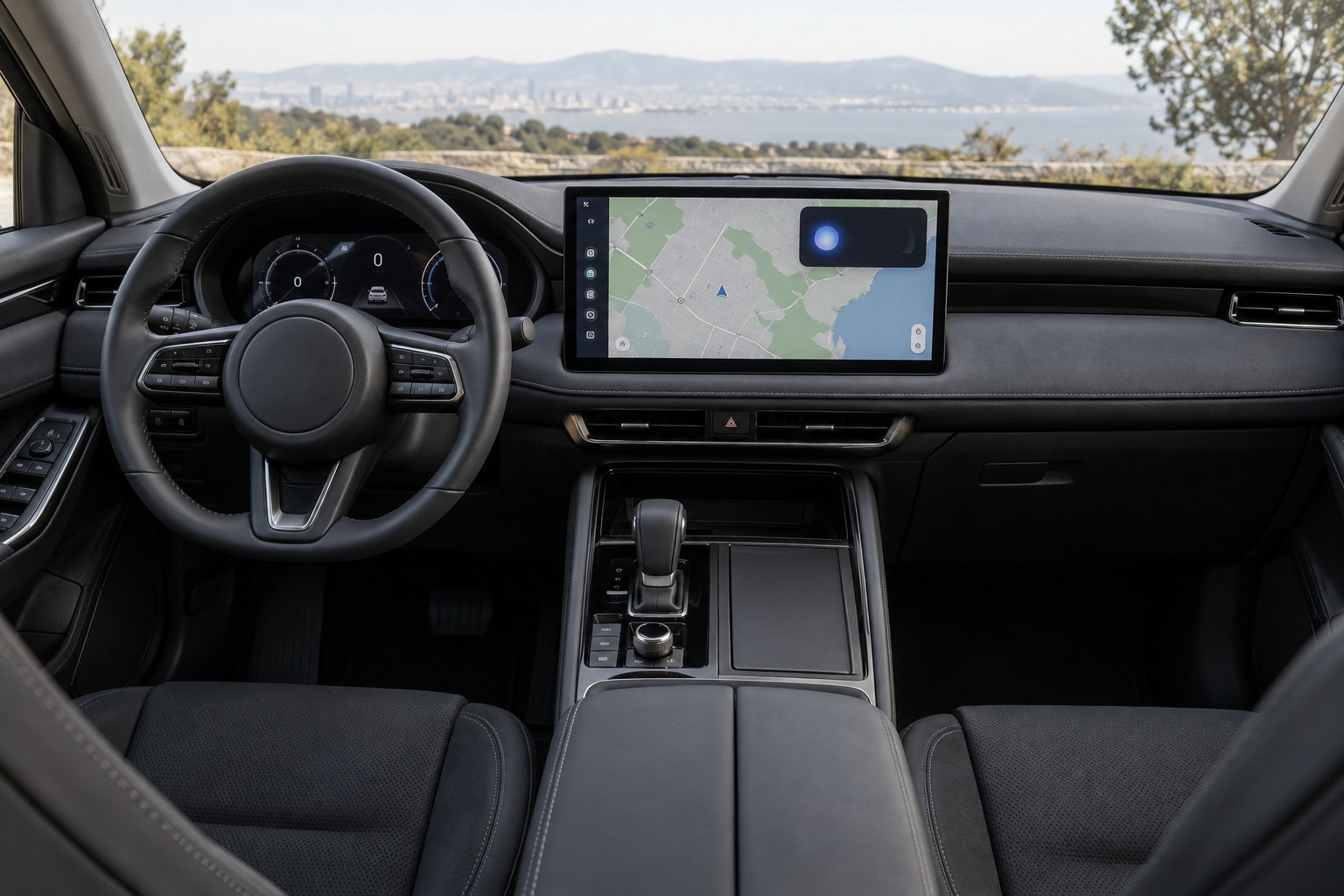
The CX-5 is the first Mazda with Google built-in: Google Maps navigation, the Google Play app store, and a voice assistant right in the car, without connecting a phone. The central screen is 12.9 inches; in the top Homura version it is 15.6 inches; the instrument cluster is 10.25 inches. Mazda removed most physical buttons from the front panel — a point British Auto Express highlights separately.
On October 26, 2026 Mazda began updating the CX-5 over the air: instead of Google Assistant, you can now enable Gemini. It understands natural language without memorized commands and follow-up questions: it finds a coffee shop with a terrace on the way, turns on music to match your mood, reads messages aloud, and helps compose or translate a reply. Gemini is enabled manually via a Google account; at launch it supports 12 European languages (including English, German, Polish) — Ukrainian is not on the list. Data for Google services is free for three years from first registration provided Mazda Connected Services is connected in the MyMazda app.
The RAV4 is the first Toyota to get the Arene software platform: a 12.3-inch instrument cluster, a 12.9-inch central screen, and over-the-air updates.
When both models will be available in Ukraine
Toyota Ukraine already offers the sixth-generation RAV4. The Ukrainian brand website lists preliminary data pending final homologation: hybrid 230/239 hp, plug-in 282/329 hp and up to 126 km on electricity — this is a different calculation method than Toyota Europe uses.
The new CX-5, according to AUTO.RIA, has appeared for order at Ukrainian dealers, and the first cars were expected to arrive in showrooms in October 2026. For Ukraine, a 2.5-liter engine rated at 188 hp is stated. We did not find an official Ukrainian page with specifications, so this data should be уточнити in with the dealer.
Which one is right for whom
- Mazda CX-5 — for those who want a roomy crossover with a large trunk, a simple naturally aspirated engine and a classic automatic, who do not need a plug and who value built-in Google services and the Gemini voice assistant.
- Toyota RAV4 — for those who drive a lot in the city and want lower fuel consumption, can charge at home and drive on electricity for up to 137 km, who need dynamics (5.8 s in the plug-in version) or all-wheel drive with a separate rear electric motor.
Other pairs we have already compared: Toyota RAV4 2026 vs Skoda Kodiaq II and the new Hyundai Tucson NX5 vs Toyota RAV4.
What accessories are already available for the new CX-5 and RAV4
For both new models, the catalog already includes model-specific 3D floor mats: Stingray 3D mats for Mazda CX-5 2025– and Stingray 3D mats and a trunk mat for Toyota RAV4 2025–. The high lip of such mats holds snow and dirt, which is especially noticeable in a crossover with a fabric floor in winter.
For the previous, second-generation CX-5 (2017–2025), the selection is broader — from original side steps to mats and mud flaps. But the new generation has a different platform and body, so do not transfer accessories from the 2017–2025 CX-5 to the new car: compatibility is indicated in each product card.
The images in the article are illustrations created from the official description of the models, not factory photos.
We deliver via Nova Poshta across all of Ukraine.
Pros and Cons of Mazda CX-5 and Toyota RAV4
Mazda CX-5: larger trunk (583 l) and rear row thanks to a wheelbase that is 115 mm longer
Mazda CX-5: a simple naturally aspirated engine and a classic automatic transmission without a traction battery
Mazda CX-5: Google built-in and Gemini assistant with over-the-air updates
Toyota RAV4: full hybrid in every version — lower fuel consumption in the city
Toyota RAV4: plug-in up to 137 km on electric power and 5.8 s acceleration
Toyota RAV4: AWD-i all-wheel drive with a separate rear electric motor
Mazda CX-5: only 141 hp in Europe and 0–100 km/h in about 10.5 s
Mazda CX-5: no full hybrid until the end of 2027
Mazda CX-5: most physical buttons have been removed from the dashboard
Toyota RAV4: the plug-in version has only 446 l of trunk space
Toyota RAV4: shorter than the new CX-5