
















































 Author: Radomskyi Maksym Vasyliovych
If the license plate is clogged with snow, dirt, or de-icing chemicals so that the characters cannot be clearly distinguished from 20 meters, the driver faces a fine under Part One of Article 121-3 of the Code of Ukraine on Administrative Offenses — 70 non-taxable minimum incomes, that is UAH 1,190. The same part also applies to a plate that is covered by objects (including transparent ones), turned upside down, unlit, or mounted not where предусмотрено. On a tuning bumper the plate is often positioned lower and at a different angle, so it gets splashed with slushy snow faster — a flat mounting base, a rigid frame, and the habit of wiping the plate before a trip help.
Contents
- What is the fine for a dirty plate and what the rules say
- What “not readable from 20 meters” means and how it is proven
- Why a plate clogs faster on a tuning bumper
- Frame or mounting base: what to install
- What you must not do with the plate
- How to keep the plate readable in winter
What is the fine for a dirty plate and what the rules say?
Since 2022, violations involving license plates have been moved into a separate Article 121-3 of the Code of Ukraine on Administrative Offenses (previously they were classified under Part Six of Article 121). Part One of Article 121-3 provides a fine of 70 non-taxable minimum incomes of citizens — UAH 1,190 — for driving a vehicle whose license plate:
- is missing, belongs to another car, or does not match established standards;
- is mounted not in the designated place, is turned upside down, or is not illuminated;
- is covered by other objects, including transparent ones, or coated with materials that make identification difficult;
- is so dirty that the characters cannot be clearly distinguished from a distance of 20 meters.
Where these requirements come from is shown in clause 30.2 of the Traffic Rules: license plates must be installed in the places designated for them; changing their dimensions, shape, color, or placement, adding extra markings, or covering them is prohibited; and the plates themselves must be clean and sufficiently illuminated. There is one exception — the rear plate may be moved to additional equipment for temporary luggage transport, for example to a bike rack.
| Situation | Does it fall under Part 1 of Article 121-3 of the Code of Ukraine on Administrative Offenses |
|---|---|
| Plate in snow or dirt, characters not readable from 20 m | Yes |
| Plate slightly dusty, characters readable | No — the article explicitly states the 20-meter condition |
| Plate behind a transparent panel or film | Yes — “covered by other objects, including transparent ones” |
| Rear plate illumination does not work | Yes — “not illuminated” |
| Plate moved to an arbitrary place | Yes — “mounted not in the designated place” |
What “not readable from 20 meters” means and how it is proven?
The key point in the rule is the distance. Dirt or snow on the plate by itself is not yet a violation: it becomes a violation when the contamination makes it impossible to clearly distinguish the characters from 20 meters. Court practice confirms this. In case No. 303/762/26 (Mukachevo, 2026), the court canceled the police fine for a dirty plate and closed the proceedings: the officers did not provide evidence that the plate was unreadable specifically from 20 meters, and the photos alone turned out to be insufficient.
Relying on court as a strategy is not worth it — it is easier to spend a minute with a brush. But knowing the threshold is useful: wiping the plate at a gas station is a reasonable requirement, not a formality.
Why does a plate clog faster on a tuning bumper?
A stock bumper is designed with a flat plate mounting area in a spot where airflow around the car is predictable. A tuning bumper or facelift bumper (usually made of composite polypropylene, PP) often has different relief: large air intakes, ribs, a full-width grille. Then the plate is placed on the edge of the bumper, on the grille, or on a lip spoiler — lower and at an angle.
- Low. The closer the plate is to the road, the more slushy snow it catches from the wheels of cars ahead.
- At an angle. A plate tilted face-up collects snow like a shelf.
- Bent. A metal plate screwed onto a curved surface flexes, and dirt sticks and freezes in the recess.
- Without support. A plate held by two self-tapping screws in the middle vibrates and over time cracks the paint and reflective film at the corners.
It is a similar story with headlights and washers in a tuning bumper — we cover them separately: why LED headlights get covered in snow and what to check on headlight washers in winter.
Frame or mounting base: what to install?
These are different parts for different tasks, and on a tuning bumper you often need both.
| Parameter | Plate mounting base | License plate frame |
|---|---|---|
| What for | Provides a flat mounting area where there isn’t one — on the edge of the bumper | Holds the plate rigidly, protects the edges from bending |
| Mounting | Bonded with adhesive sealant | Clips or screws |
| When needed | Relief-type tuning bumper, nowhere to screw the plate on evenly | Any car, especially when the plate flexes or vibrates |
| What to consider | Do not block air intakes, parking sensors, or the camera | Do not cover the plate characters |
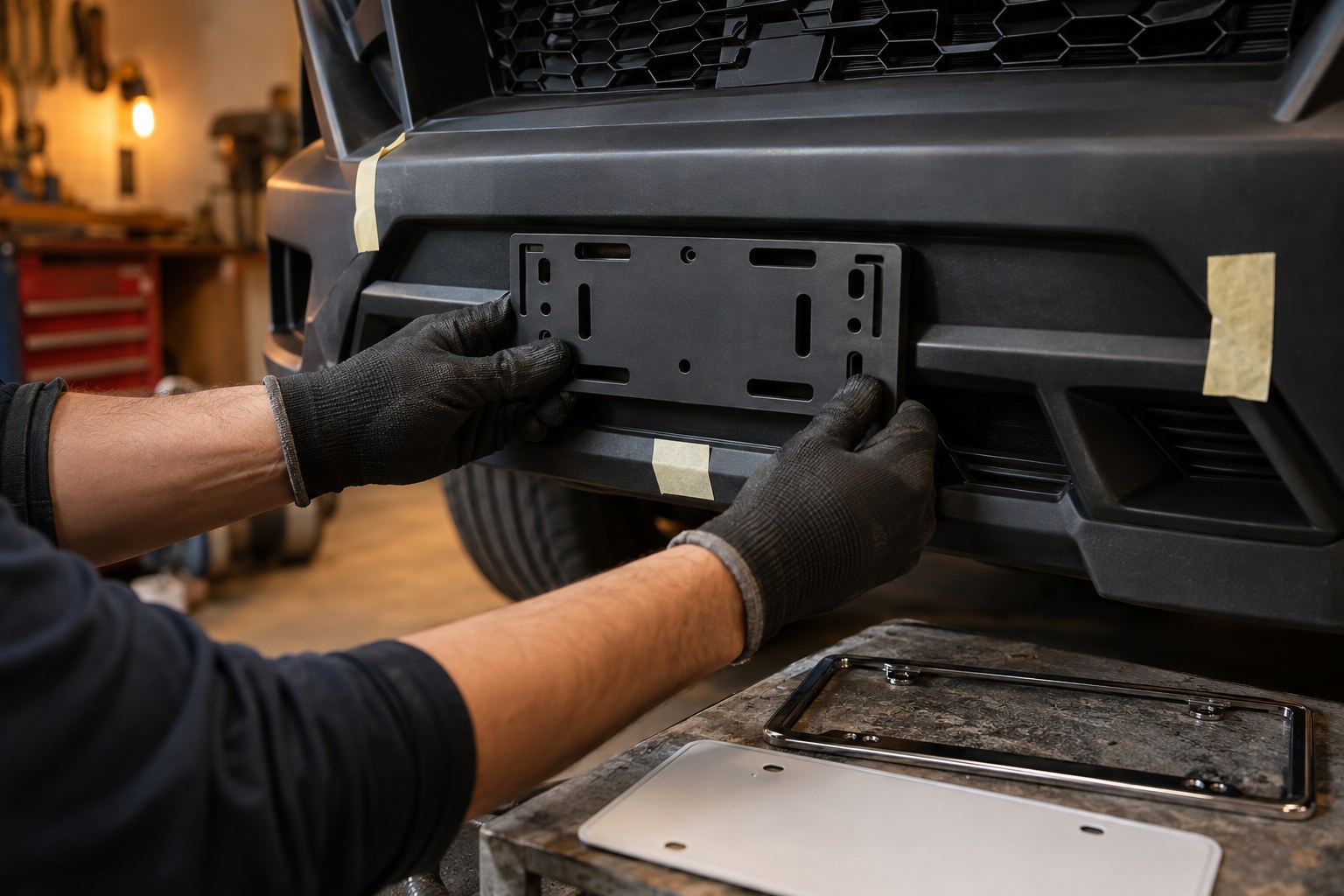
In the catalog there is a universal plate mounting base for the bumper edge — matte black, fiberglass, bonded with glass adhesive sealant (adhesive is not included) — and a separate option for Mitsubishi Lancer X. License plate frames — chrome-plated, made of stainless steel on a plastic base; there are universal ones and ones with brand names (BMW, Mercedes-Benz, Volkswagen, and others).
How to choose a spot for the mounting base
- The plate should be vertical or almost vertical — not “facing the sky”.
- In the center of the bumper or where the plate was in the factory version of the model — so there are no questions about a “non-designated location”.
- Not over parking sensors, the adaptive cruise radar, or a camera: the plate in front of them can interfere with their operation.
- Not on moving flexible parts: a lip spoiler touches curbs and snowbanks, and a plate on it will not last long (about snowbanks — a separate article).
What you must not do with the plate?
- Install transparent “protective” panels, glass, or film over the plate — this is “covered by other objects, including transparent ones”.
- Apply stickers, coatings, or tinting to the plate.
- Bend, trim, or paint the plate to make it “fit” a tuning bumper — this changes its size and shape, which is prohibited by clause 30.2 of the Traffic Rules.
- Install a frame that overlaps the characters: the frame should border the plate, not cover it.
- Drive with the rear plate illumination not working.
- Turn the plate upside down or remove it “for the winter”.
How to keep the plate readable in winter?
- Brush the plates along with the glass and headlights — with a brush, not a scraper: a scraper scratches the reflective film.
- After highway driving, wash the plates together with the headlights — de-icers and salt dry into a gray film that is harder to read through.
- Check the rear plate illumination: it gets dark early in winter, and that is when it is needed most.
- If the plate flexes or vibrates, install a frame, and on a relief bumper — a mounting base, so the plate lies flat and does not collect slush in recesses.
- A plate with peeling paint or film is harder to read even when clean — then the question is about the plate itself, not the dirt.
We deliver via Nova Poshta across all of Ukraine.
How to mount a license plate on a tuning bumper so it stays readable
- Choose the location Place the plate against the bumper: it should sit vertically, centered or in the model’s factory position, not block the air intakes, parking sensors, radar, or camera, and not hang over the lip spoiler.
- Test-fit the bracket If there is no flat area, test-fit the license plate bracket on the edge of the bumper and mark its position with masking tape. Make sure it does not rest against the grille and does not interfere with opening the hood or trunk lid.
- Prepare the surface Wash and dry the bonding area, then degrease it. In winter, do this in a warm garage: adhesive sealant holds poorly on cold, wet plastic.
- Glue the bracket in place Apply adhesive sealant to the bracket, press it into position according to the markings, secure it with tape, and allow the full curing time specified in the adhesive instructions.
- Secure the plate in the frame Insert the plate into the frame and screw it to the bracket or bumper so that the frame does not cover the characters, and the plate does not bend or vibrate.
- Check readability Step back about 20 meters and check that all characters are clearly visible, and in the evening — that the rear plate light works.