















































 Author: Radomskyi Maksym Vasyliovych
Ice behind the wheel arch liner rarely breaks a car by itself, but a lump of wet snow frozen to the liner adds weight and pulls it down—and on many cars the liner is screwed to the edge of the bumper. That is why the clips and self-tapping screws at the junction of the liner and the bumper most often suffer—especially when the ice is knocked off with a foot or a shovel. Safest: let the ice thaw somewhere warm or at a car wash, remove the snow with a soft brush, and then check the fasteners on both sides.
Contents
- Why ice behind the wheel arch liner is dangerous for the bumper
- How to tell that ice has built up in the wheel arches
- What you must not use to knock ice out of the arches
- How to safely clean the arches in winter
- How to check the wheel arch liner and bumper fasteners
- When it is better to replace the wheel arch liner
Why is ice behind the wheel arch liner dangerous for the bumper?
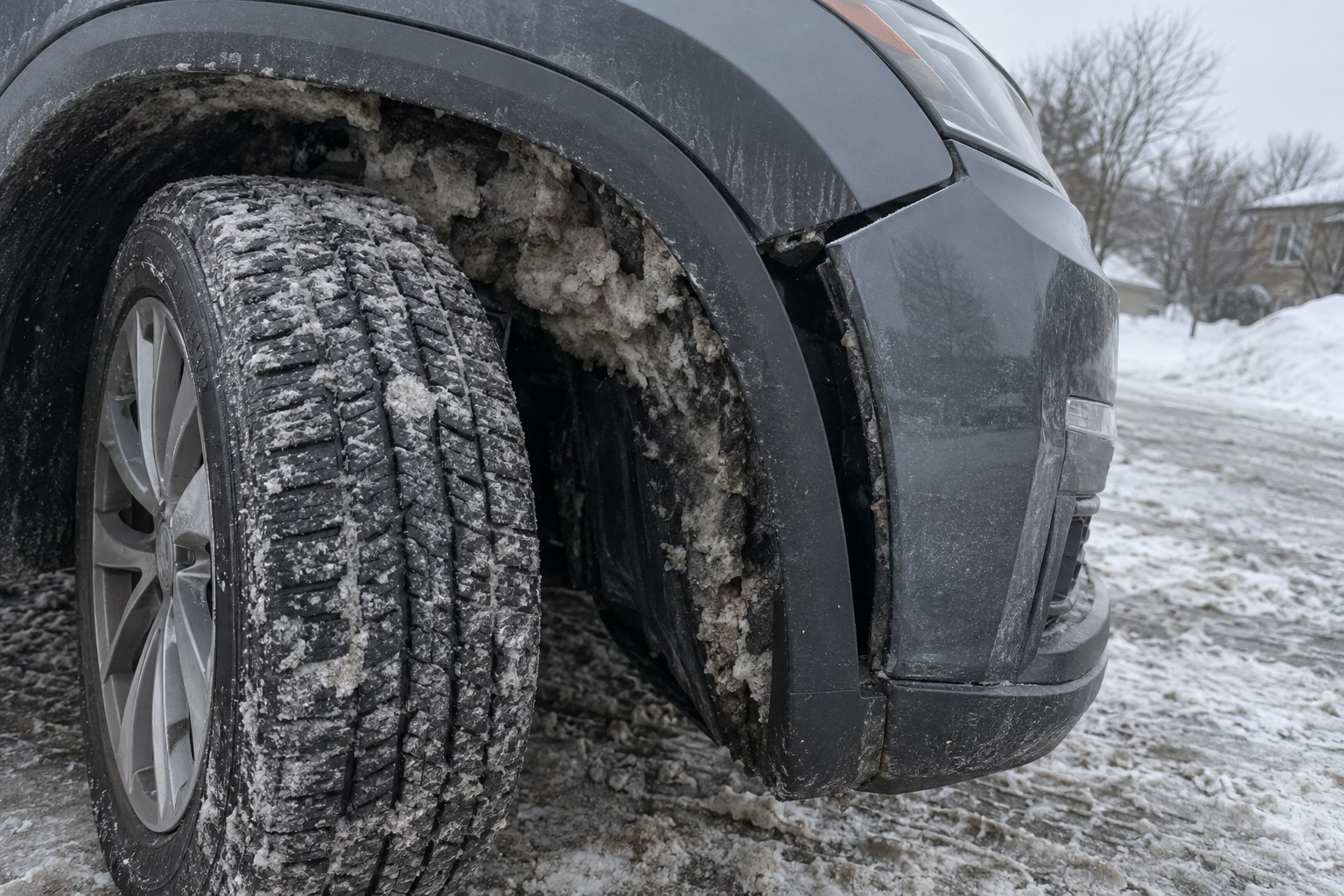
The wheel constantly throws wet snow and slush into the arch. During the day they thaw, at night they freeze, and within a few days a dense lump grows on the inner surface of the liner. This happens especially quickly when the car is parked outside after driving through a rutted snowy track.
The front wheel arch liner is not held only on the fender arch. On most modern cars, its front edge is attached with clips or self-tapping screws to the bumper, and the bumper itself in this area sits on a side guide. This means the weight of the lump and any jolt to it are transferred to the thin plastic edge of the bumper and its tabs.
Manufacturers, including Toyota, state that they test their cars in cold conditions and that snow buildup in the arches does not harm the vehicle. In practice, owners describe something else: as a heavy lump falls off, it tears off the wheel arch liner along with the clips, and then ice starts packing in behind it, into the fender cavity. The conclusion is simple: what is dangerous is not so much the lump itself as the moment when it breaks off while driving or when it is knocked off with force.
How to tell that ice has built up in the wheel arches?
- At full steering lock you can hear rustling or the tire rubbing against something hard.
- Vibration appears at speed: snow packed between the spokes of the wheels upsets wheel balance.
- The wheel arch liner has visibly sagged, and the clearance between it and the tire has decreased.
- The edge of the bumper near the arch has pulled away from the fender, and an uneven gap has appeared.
- The wheel arch liner “shivers” or flaps over bumps.
If you notice at least one sign, do not wait for a thaw: it is better to clean the arches soon, before the lump grows even more.
What you must not use to knock ice out of the arches?
The most common mistake is hitting the lump with a foot or a shovel. Frozen plastic becomes more brittle in the cold, and the blow often breaks not the ice but the clip, the bumper tab, or the liner itself. The same applies to using a hammer, a glass scraper, or a screwdriver to pry up the lump near the bumper edge.
- Do not pour boiling water: the sudden temperature change harms plastic and the paintwork.
- Do not hold a high-pressure washer jet right up against the clips and the joint between the liner and the bumper—it pulls out the fasteners and lifts the edge.
- Do not scrape snow off the wheels with hard objects: you can knock off the balancing weights, and the vibration will remain even after cleaning.
A separate situation is hitting a snowbank with the bumper. The damage there is different, and we covered how to look for it in the article about hitting a snowbank with the bumper.
How to safely clean the arches in winter?
The easiest way is to let the ice thaw: a few hours in a warm parking garage or garage, or a car wash with warm water. The softened lump comes off on its own or with a light touch of a soft brush. Step-by-step instructions are in the block below.
After cleaning, it is worth rinsing the arch to remove road salt. Under the lump, de-icer can sit for weeks, and the arch edge and fastening points are among the first places where corrosion appears. If your arches have trims or fender flares, also check whether salt has packed underneath them: see the article about arch trims and fender flares in winter.
How to check the wheel arch liner and bumper fasteners?
The inspection takes 10–15 minutes; a flashlight and gloves are enough. Compare the left and right sides—lack of symmetry quickly shows where something has torn off.
| What to check | How | What is a warning sign |
|---|---|---|
| Clips and self-tapping screws at the joint with the bumper | Turn the wheel to full lock and look behind the bumper edge | Empty holes, a clip hanging on one side |
| Bumper edge near the arch | Gently pull by hand | The edge freely pulls away from the fender or “moves” |
| Gap between the bumper and the fender | Compare with the other side | The gap is wider or uneven |
| The wheel arch liner itself | Inspect along the full arch curve | Cracks, torn mounting holes, sagging |
| The cavity behind the liner | Shine a light into the gaps near the edge | Remaining ice, dirt, exposed metal |
If only one or two clips are torn out, it is enough to replace them with the same size. But if the holes in the liner are ripped or a bumper tab has cracked, a new clip will not hold for long—it is better to show the car to a body repair specialist.
When it is better to replace the wheel arch liner?
The wheel arch liner should be replaced when it is cracked along the arch, when the mounting holes are torn so that the clip does not hold, or when it is missing altogether—because without it, ice packs directly into the fender cavity, up to the wiring and bumper mounts. When replacing it, make sure the new liner fits the factory mounting points for your specific body: on the same model, pre-facelift and facelift versions may have different mounts near the bumper.
Vehicle-specific wheel arch liners are collected in the section wheel arch liners for cars—for example, wheel arch liners for Lexus LX570, kits for Lexus GX460 and Dacia Duster 2018–2024, and a separate front right DPT wheel arch liner for BMW 3 Series F30/F31. We discussed how plastic differs from other materials in everyday use in the article about plastic and aluminum wheel arch liners. If the bumper itself was damaged by an impact, you can choose a replacement in the bumpers section.
We deliver with Nova Poshta throughout Ukraine.
How to safely remove ice from wheel arches and check wheel arch liner fasteners
- Thaw the ice Leave the car in a warm garage or parking lot for a few hours, or drive through a car wash with warm water. The softened mass will come off easily.
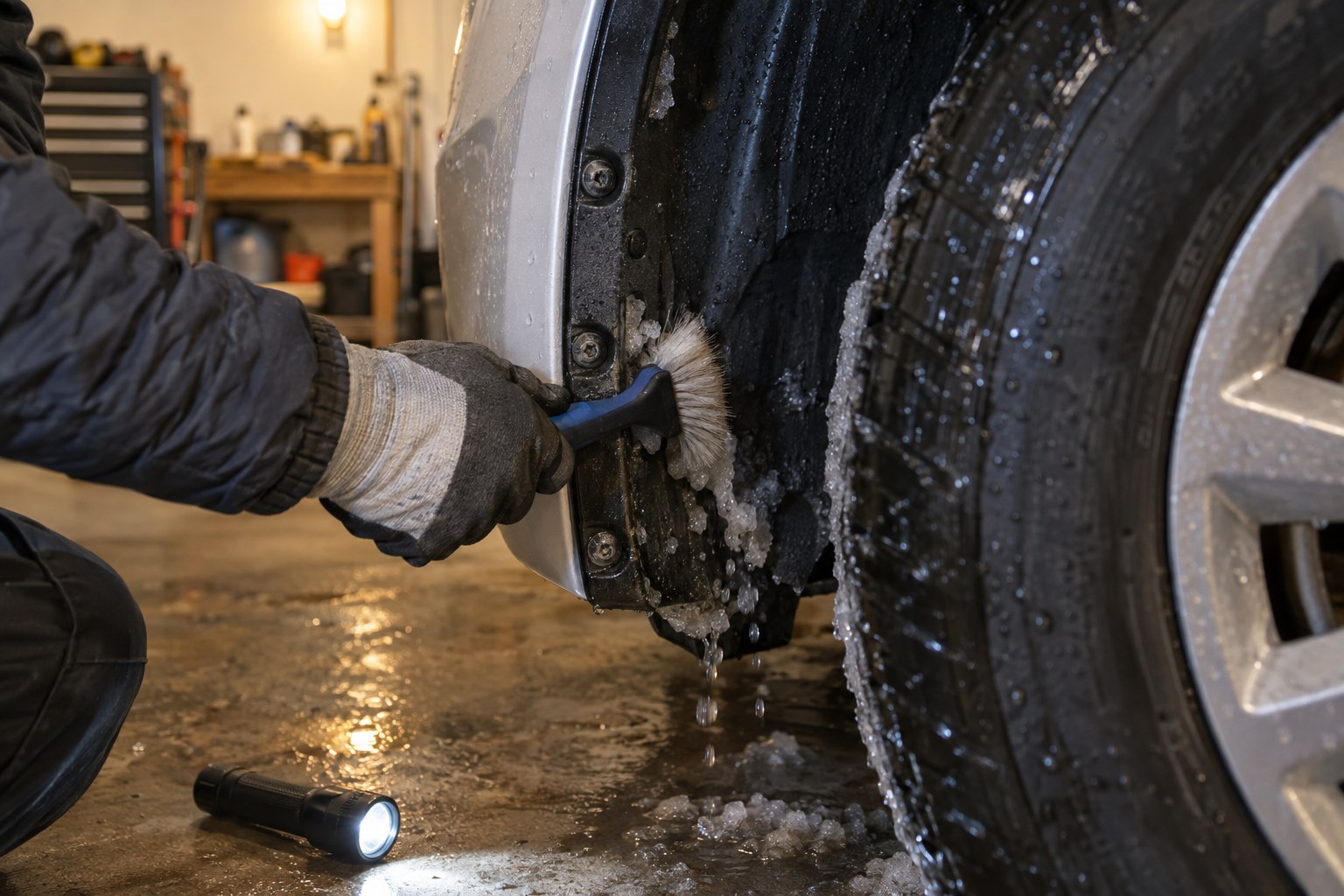
- Remove the snow with a soft brush Turn the steering wheel all the way to open up the wheel arch, and sweep away the snow and softened ice with a brush with a plastic handle. Do not pry at the mass near the edge of the bumper.
- Rinse the wheel arch with salt off Rinse the wheel arch liner, the arch edge, and the wheels with a moderate stream of water. Do not hold the washer nozzle too close to the clips or the joint between the wheel arch liner and the bumper.
- Inspect the joint of the wheel arch liner and bumper Use a flashlight to check whether all clips and self-tapping screws are in place, whether the holes are torn, and whether the edge of the bumper is coming away from the fender.
- Compare the left and right sides Check whether the gaps between the bumper and the fenders, and between the wheel arch liner and the tire, are the same. A difference will show where the fastener has come loose.
- Replace the broken part Replace stripped clips with the same type. Show a cracked wheel arch liner or bumper tab to a body shop technician, or replace the part.